Thinks 28

A Mint series on 30 years of India’s reforms.

Ideology Isn’t About Ideas: Michael Huemer. “What I mean is that (a) the reasons people choose an ideology are extraneous to the intellectual characteristics of the ideology (the arguments, the evidence, the explanatory virtues) and more to do with arbitrary extrinsic characteristics, like who else holds that ideology, or what vague emotional associations it carries, and (b) most people don’t take the contents of their ideology all that seriously — they don’t actually use it to understand the real world. It’s mostly something to say, and to berate other people for not saying. They use ideological debate as a proxy for tribal contests. They don’t support group G because of idea X; they support X because it’s the idea associated with G.”

Jim Collins: “Lead with questions, not answers. Leading from good to great does not mean coming up with the answers and then motivating everyone to follow your messianic vision. It means having the humility to grasp the fact that you do not yet understand enough to have the answers and then to ask the questions that will lead to the best possible insights.”

Thinks 27

Alex Tabarrok on the US: “We will get to herd immunity in 2021…one way or another.” We are probably already there in India! Nitin Pai on why Why India will not see a big second wave of Covid-19.

TN Ninan on manufacturing and services in India’s future: “Perhaps the time has come to acknowledge that India is not going to replicate the export orientation of the East Asian manufacturing story, or even that of Bangladesh. If the country does build manufacturing into a bigger component of GDP, which has been the official objective from 2012, it will be oriented towards the domestic market, and probably high-cost…The story to compensate for this will come from services…The implication for the finance minister is that more fiscal transfers to the bottom tier will become unavoidable, and cannot be funded if concentrated wealth at the top is not taxed.”

Via CafeHayek: “Politicians are not pilots of a ship of state, and yet public rhetoric makes them appear to be just that. Actually, there is little politicians can do actively to promote human flourishing other than secure peace, keep taxes low, and administer justice tolerably well. If they stick to this recipe, they will avoid inserting harm into society. That is the best situation any society can attain.”

Thinks 26

David Samuels: “The people who populate the institutions that exercise direct power over nearly all aspects of American life from birth to death are bureaucrats—university bureaucrats, corporate bureaucrats, local, state and federal bureaucrats, law enforcement bureaucrats, health bureaucrats, knowledge bureaucrats, spy agency bureaucrats. At each layer of specific institutional authority, bureaucrats coordinate their understandings and practices with bureaucrats in parallel institutions through lawyers, in language that is designed to be impenetrable, or nearly so, by outsiders. Their authority is pervasive, undemocratic, and increasingly not susceptible in practice to legal checks and balances. All those people together comprise a class.” (Via Arnold Kling.) True in India also.

A good idea from Shankkar Aiyar: “Opposition must compete, present ‘shadow’ budget..A shadow budget could enable parties to answer many questions and outline the approach to sectoral challenges… The political economy of the world’s largest democracy hosting over a billion aspirations deserves choice, a plurality of competing ideas on issues of lives and livelihoods.”

Jim Collins: “Do you have a “to do” list? Do you also have a “stop doing” list?”

Thinks 25

Jim Collins: “Most great leaders don’t begin as great leaders. Sure, there are a few weird freaks of nature that seem to be born for leadership, who are fascinating to look at, like some sort of exotic bug. They’re also largely irrelevant; you simply can’t do anything about whether you’re born as one of those weird, freaky bugs. And—this is the crucial point—most exceptional leaders grow into their capabilities. Not because they want to “be” a great leader, but because they’re trying to be worthy of the people they lead. If you want the people with whom you work to improve their performance, first improve your own. If you want others to expand their capabilities, first expand your own.”

Stacey Rudin: “By exploiting our social relationships and turning our peers into a police force, governments make themselves into judge, jury, and executioner. There is not even a right to a fair trial. The end result is a shredded societal fabric, ever-looming ostracism, rampant awkwardness, underground rule-breaking, resentment, frustration, and distrust… Today, they implement a covert replacement for the rule of law, one that subverts our will to theirs with no right of appeal. Tomorrow, they replace democracy.”

The Role of the Market in the Third Way of Entrepreneurship: A conversation with Peter Boettke. “he Third Way of Entrepreneurship steers a middle course between the unregulated pursuit of lower-level interests (laissez-faire) and centralized planning. It’s not as if markets have no role to play, but they must be structured so that the three ingredients of a cultural evolutionary process—selection, variation, and replication—are managed to achieve whole-system goals.”

Thinks 24

Jim Collins on “First Who, Then What”. “We live in a “what” culture. We ask political candidates, what are you going to do about [education or foreign policy or the budget or whatever]? We ask aspiring entrepreneurs, what’s your great idea? We ask young people, what career will you choose? We ask mentors, what job should I take? We ask, what should we do to solve a pressing problem? Not that these are bad questions, but they’re secondary to the question of who.”

Donald Boudreaux: “People who seek political power are, with exceptions too rare to matter, never to be trusted; at best, such people are vain and officious busybodies. People who actually achieve political power are to be trusted even less than those who seek it without success; winning elections requires a measure of deceitfulness and Machiavellian immorality that no decent person comes close to possessing.”

Watched: The Trial of the Chicago 7. Relevant in the context of the recent US events.

Thinks 23

12 Principles of International Trade: by Donald Boudreaux. “Government officials often have incentives to pursue policies that yield benefits to special interest groups while damaging the citizenry as a whole. In few policy areas is this lesson’s validity proven more regularly than in trade policy. Protective tariffs and export subsidies enrich a narrow sliver of politically influential producers at the larger expense of the general public.” This is what we have now started to see in India – a return to the 1960s and 70s.

Arnold Kling on Content Moderation

Jim Collins on Story-telling: “The story is the, is the, is the human vessel for teaching an idea. There are maybe 30 different stories you could pick to help somebody really grasp an idea, but picking the right one for the right audience at the right time, that I think is the art. Take The Illiad, which I’ve read multiple times. It is a story about honor. But maybe if you want to communicate the same idea, you instead teach about Katharine Graham taking over The Washington Post and facing this really difficult choice after her husband had committed suicide. She has to step outside the walls and, and, and fight for what is dear, which is the soul of The Post and its role in the world. And, and that’s a human story, right? But it ties into something deep and timeless.”

Thinks 22

Understanding Mob Psychology: from NYTimes. “A major shift in thinking about crowd behavior occurred in the middle of last century, and it integrated two competing principles. One is that, under specific conditions, peacefully minded protesters may indeed act out — for instance, when a barricade is broken by others, when the police strike down someone nearby. At the same time, as a rule, impulsive violence is less likely to occur in crowds that have some social structure and internal organization.”

Fred Wilson on Mentors: “The thing about mentors is you can’t really ask someone to mentor you. It kind of happens organically. Someone takes you under their wing. They see something in you and want to bring it out, develop it. That’s how the best mentor/mentee relationships happen. And they are so great…So if you are early in your career, look for opportunities to connect with someone a few decades ahead of you to help you figure stuff out.”

Friedrich Hayek: “A society that does not recognize that each individual has values of his own which he is entitled to follow can have no respect for the dignity of the individual and cannot really know freedom.”

Thinks 21

Email and Madtech: “The best and simplest starting point for a convergence of adtech and martech is with email. Email enables a MADtech strategy by serving as both a critical data point—the unique unifying identifier—and by pulling double-duty as both a martech and an adtech tool.”

Mint edit on Minimum Government: “As a proposition, ‘minimum government’ has held special appeal in the economic sphere as a reformist mantra. This is no surprise in a country that saw an outsized state retard our growth prospects for decades before we embarked on liberalization. That the same ideal must guide India’s social policy framework, however, seems lost on too many lawmakers. Witness the surfeit of laws and policies we have seen that invade our private space, baring a tendency towards a maximalist state all too keen to impose itself on our personal lives.”

Abraham Lincoln: “Nearly all men can stand adversity, but if you want to test a man’s character, give him power.”

Thinks 20

The Evolution of Cloud: “While the past fifteen years of the cloud transition has produced some large and likely enduring companies, today we are seeing new companies that are not part of the cloud transition or a hybrid cloud generation. They aren’t even cloud-first– they are cloud only. What does this mean? Founders and companies built for cloud only are not trying to serve legacy and cloud environments. They are cloud native and cloud only. They are built and architected from the first lines of code to take advantage of cloud compute, storage, and networking, in the same way that software written in the 1990s was assumed to be running on Windows or Solaris.”Scott Gottlieb, MD on Twitter: “As current epidemic surge peaks, we may see 3-4 weeks of declines in new cases but then new variant will take over. It’ll double in prevalence about every week. It’ll change the game and could mean we have persistent high infection through spring until we vaccinate enough people.”

Journalism, media, and technology trends and predictions 2021: “This will be a year of economic reshaping, with publishers leaning into subscription and e-commerce – two future-facing business models that have been supercharged by the pandemic.”

On Stoicism: ” It is a deeply individual and inward looking practice of meditation that requires you to renounce judgement of external things, including the actions of others. Unlike almost all other things called philosophies, it is explicitly not a world view. Meditating on Stoic mantras helps you accept our inability to control the world, and therefore the pointlessness of taking a world view in the first place. Instead, Stoicism encourages you to focus on maximizing the good within yourself, as that is all that is within your control.”

Thinks 19

Tim Berners-Lee’s next (from NY Times): “The idea is that each person could control his or her own data — websites visited, credit card purchases, workout routines, music streamed — in an individual data safe, typically a sliver of server space. Companies could gain access to a person’s data, with permission, through a secure link for a specific task like processing a loan application or delivering a personalized ad. They could link to and use personal information selectively, but not store it.”

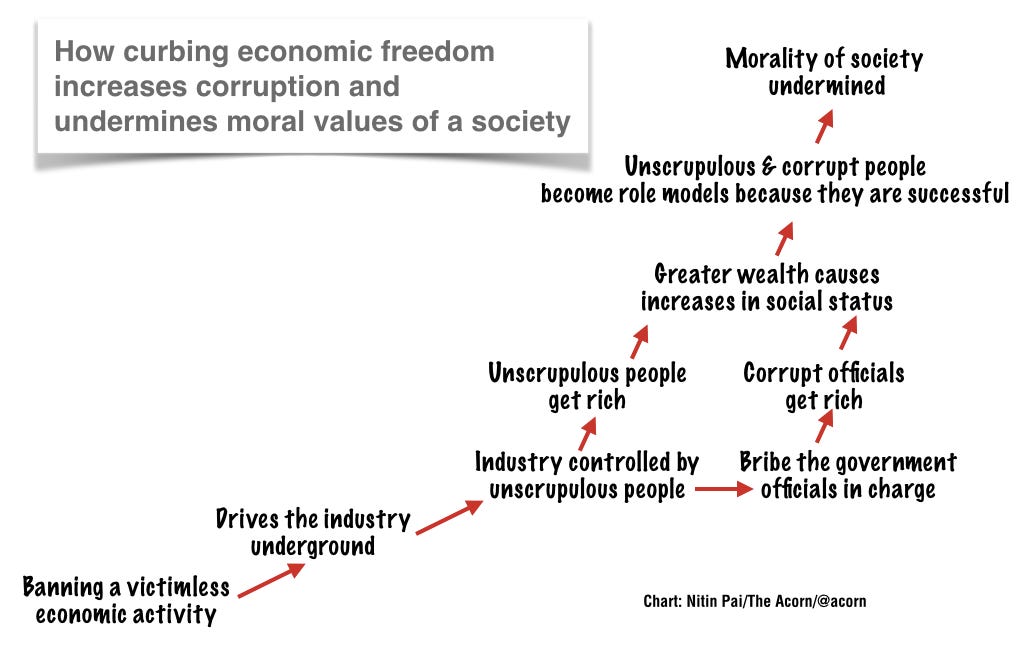
From Nitin Pai (via Anticipate the Unintended newsletter):

https://cdn.substack.com/image/fetch/f_auto,q_auto:good,fl_progressive:steep/https%3A%2F%2Fbucketeer-e05bbc84-baa3-437e-9518-adb32be77984.s3.amazonaws.com%2Fpublic%2Fimages%2F4f6460f6-e893-490b-9d0e-754091b3394f_1018x648.png

Milton Friedman: “We will not solve our problem by electing the right people. We will only solve our problem by making it politically profitable for the wrong people to do the right thing.” (via Atanu Dey)