Thinks 162

Nancy Sherman: “The early Stoics taught that we are world citizens connected to all of humanity through our reason. Marcus Aurelius paints a graphic image in his “Meditations.” He jots his notes in the quiet of nightfall after a day of battle during the Germanic campaigns. The detritus of the battlefield is on his mind: Picture a hand and head lying apart from the rest of the body. This is what a person makes of himself when he cuts himself off from the world. We can’t be “at home in the world,” a Stoic catchphrase, if the good is reduced to self-interest, or grit is defined as go-it-alone self-reliance.” [NYTimes]

A 2016 essay by TCA Srinivasa Raghavan on the Indian Constitution: “The simple truth is that although it is a fine document from an aspirations point of view, it is simply not a practical one for a politically independent India. It suffers from two flaws. One is that its design and purpose is a colonial one: that is, of a very strong central government that the British had prescribed via the Government of India Act, 1935. That Act was not designed for change or even managing change; it was prescribed for maintaining the status quo. The other problem is that it gets into too much detail of the administrative kind.”

Donald Boudreaux: “Government borrowing changes the identities of the particular taxpayers who incur the costs of government projects; government borrowing does not, however, enable taxpayers – considered as a group over time – to escape these costs. Government projects undertaken today and paid for with current tax revenues are paid for by taxpayers today. Government projects undertaken today and paid for with borrowed funds are paid for by those taxpayers who will be responsible for servicing and repaying the debt – namely, taxpayers tomorrow. While in principle some worthwhile projects – such as a hydroelectric dam that will operate for 75 years – are better funded with debt than with currently raised tax revenues, even these projects are costly. Buchanan warned that debt-financing’s shifting of the burden of paying for government projects and programs from current taxpayers to future taxpayers will incite current taxpayers to consume too much through government.
Prashnam Survey on Covid Deaths quoted in The Economist

On June 2, I had written a column in ThePrint based on a Prashnam survey about the number of deaths due to Covid. The latest Economist (June 12 edition) has written about it as part of their story on estimating the Covid deaths in India. The story is headlined “More evidence emerges of India’s true death toll from covid-19” with the stub “New surveys corroborate earlier estimates that the number is some six times higher.”

Evidence from another source, opinion surveys, corroborates the higher numbers. One, conducted in May by Prashnam, a new polling group, asked 15,000 people, across mostly rural areas in Hindi-speaking states in the north, whether anyone in their family or neighbourhood had died of covid-19. One in every six, or 17%, said yes.

Rajesh Jain, Prashnam’s founder, then compared this result with surveys in America that had asked a similar question, including one conducted in March by the University of Chicago, which found that 19% of respondents had a close friend or relative who had died in the pandemic. Given the closeness of those results, Mr Jain says that India’s overall covid-19 mortality rate is likely to be closer to America’s, at 1,800 deaths per million people, than to its official figure of 230 per million. If India’s rate does match America’s, the number of deaths in India so far would be about 2.5m, he says.

PS: The same survey was also linked from an article in The New York Times.

Additional resources on Prashnam:


Thinks 161

How mRNA became a vaccine game-changer: from FT. “Rossi was inspired by Shinya Yamanaka, a Japanese scientist who had proved it was possible to turn any cell in the human body into an embryonic stem cell-like state by inserting four genes. Yamanaka’s discovery eventually won him the Nobel prize. But there was a problem: the genes he inserted ended up back in the DNA, a mutagenic event that increased a person’s chance of developing cancer…Rossi’s idea was to replicate the Japanese scientist’s achievement using mRNA instead, to reprogramme human skin cells so they could act as though they were stem cells.”

Eliot Peper: “Speculative fiction is all about asking “what if?” What if a lone astronaut got stranded on Mars? What if genetic engineers resurrected dinosaurs and stuck them in an amusement park? What if we are all living in a simulation? The question that sparked my latest novel, Veil, is “what if a billionaire hijacked the climate with geoengineering?” These questions are hooks. They capture the imagination and pique curiosity. That’s all well and good, but it’s only a starting point.To pay off a speculative setup, you need to keep the dominos falling as second-, third-, and fourth-order effects ripple out through the story. Momentum builds. Progressive complications tighten the ratchet. Unexpected reversals fling the reader forward.” [Techcrunch]

Atanu Dey on systems versus goals: “goals are for losers. That’s literally true most of the time. For example, if your goal is to lose ten pounds, you will spend every moment until you reach the goal—if you reach it at all—feeling as if you were short of your goal. In other words, goal-oriented people exist in a state of nearly continuous failure that they hope will be temporary. That feeling wears on you. In time, it becomes heavy and uncomfortable. It might even drive you out of the game… In the world of dieting, losing twenty pounds is a goal, but eating right is a system. In the exercise realm, running a marathon in under four hours is a goal, but exercising daily is a system. In business, making a million dollars is a goal, but being a serial entrepreneur is a system.”

Microns and Loyalty: Gamifying and Rewarding Attention (Part 9)

Can It Work?

What I have described above is a theoretical construct. At present, microns are in their infancy (we are just getting started with the idea at Netcore). Emails have generally been free from incentivisation; so, to imagine a loyalty program for microns can be considered as wishful thinking at this stage. Making one idea a success is hard enough, and here I am combining two big ideas together – microns and loyalty. So, can it really work? Let’s take them one at a time and then together.

We are being flooded with brand emails in our inbox – and all sorts of other messages in our other inboxes (SMS, WhatsApp, Facebook Messenger) and feeds (Twitter, Instagram, Snap, Pinterest). Brand messages have to compete in our inboxes with messages from family and friends, and the various groups and communities that we are part of. Attention is the prize that everyone wants and it is getting splintered into micro-moments where the mindset is more ignore and delete, rather than read and delight. It is in this world that microns can come like a breath of fresh air.

Emails come into our mailbox rather than us seeking them out and that is their superpower. With a focus on building a long-term relationship and a daily habit, some brands can become part of our life with the useful information that they provide. Microns are the best carrier for such nuggets – short and simple, clearly identified and useful. Made-for-mobile microns are the vehicle for brands to become friends. Friends are always welcome to connect with us; similarly, brands can use microns to make that connection via a subscription. Content will play a critical role for making microns work; too much promotional messaging and customers will opt-out or ignore. AMP offers a way to make microns interactive and open a whole new world of interesting use cases. That has been the thinking behind us creating MyToday, a made-for-microns publishing-subscription platform.

Adding elements of loyalty and gamification can make microns much more rewarding. Our attention has a lot of competition; if someone is willing to pay us for it, they have the potential to stand out. By disintermediating the media and ad platforms, brands can build a direct hotline to their customers, with the rewards working as magnets for visibility, engagement, actions and eventually, transactions.

While many brands have their own loyalty programs and could potentially add microns as another mechanism to earn additional points, a better approach would be to start with the customer’s inbox and craft a rewards program that incentivises all actions done within. This would necessarily have to then be a loyalty program that cuts across brands – that is what I have described in this series. Inbox attention is the prize; and there is no better inbox than the email inbox. Every other inbox has its limitations – SMS costs a lot and is limited to text, RCS is not widely available and dependent on the mobile operator, others like WhatsApp are controlled by a single entity who can alter the rules at will. The only mailbox free from monopoly control is the email inbox.

**

To summarise, there is a very interesting opportunity to build a loyalty program which monetises attention via microns by building a two-sided platform: connecting brands and consumers. It needs to have two components: the earn (how consumers can get the reward points) and the burn (how can they redeem these points). The innovative format of microns (short, informational, identified content) combined with a multi-brand loyalty program can lay the foundation for a big breakthrough in brand-customer engagement via the most ubiquitous identity that customers have – their email address. Such a program could, in short order, become the world’s largest loyalty program.

The entity that does it successfully can then open up the exciting world of rethinking the inbox itself for microns. Hotmail created a personal inbox for us in the late 1990s, Gmail made it hugely better in the first decade of the 21st century, and WhatsApp reinvented it for the mobile era in the 2010s. Imagine a new inbox for the 2020s that connects an individual’s dual identity (email address and mobile number) with a focus on brand messages rather than P2P and group messages. Microns can serve as the building block for this next-generation ‘gamified’ inbox. That’s our next story.

Thinks 160

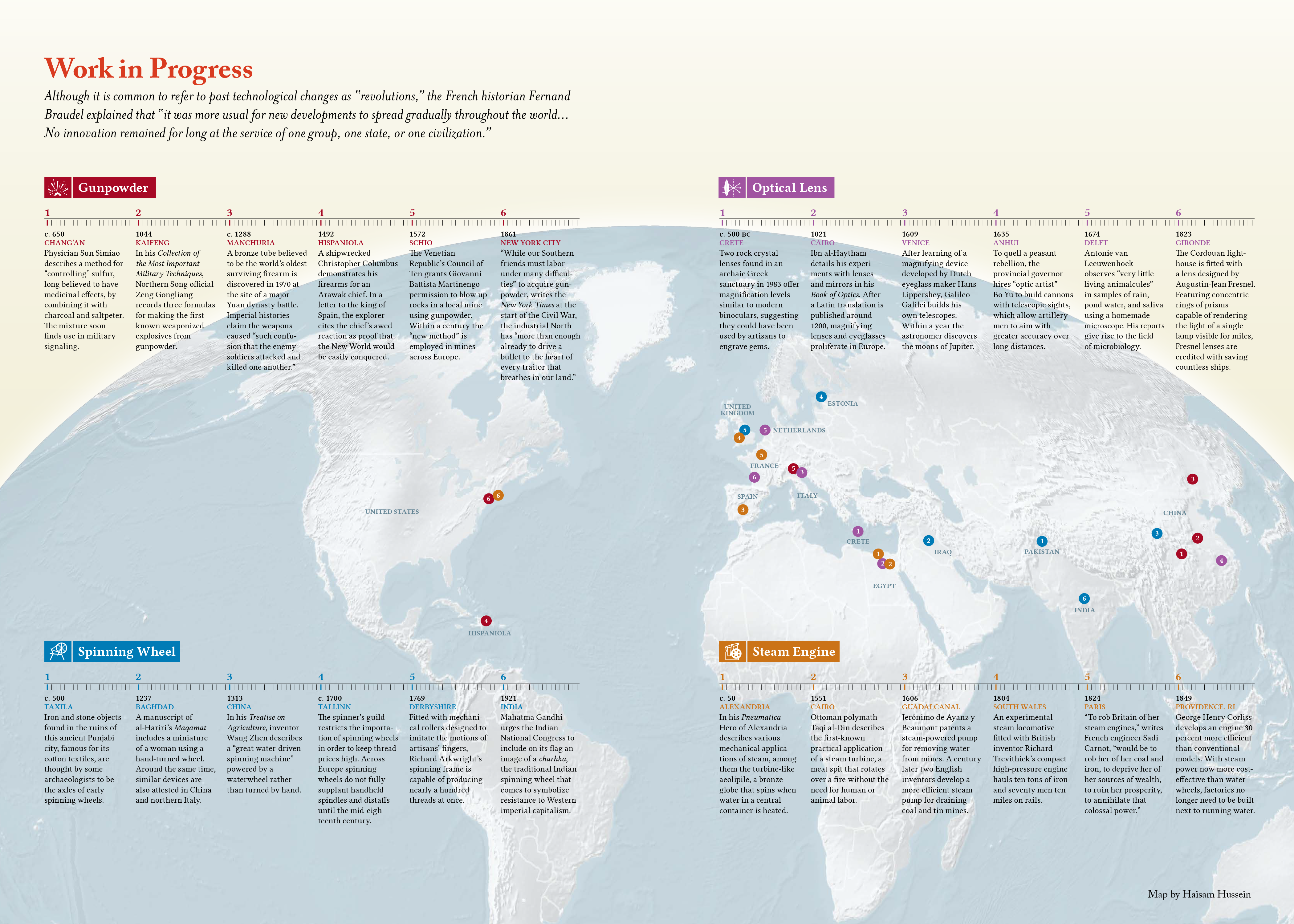
How technological innovation spreads

Daniel Kahneman: “Noise in general is unwanted variability. That is, when there is a judgment or a measurement or a decision, and there is variability, and the variability can be across occasions. When the same person judges the same object many times and reaches different conclusions, that’s one kind of noise. And the other kind of noise is what we call system noise.”

Shane Parish: “What seems like a difference in talent often comes down to a difference in focus. Focus turns good performers into great performers. Two keys to focus are saying no to distractions and working on the same problem for an uncommonly long time. Both are simple but not easy.”

Microns and Loyalty: Gamifying and Rewarding Attention (Part 8)

My Wishlist

I asked myself: as an email subscriber of many brand newsletters and a loyal customer of many brands, what would an interesting microns loyalty program look like?

  • Identify microns and points clearly: the Subject line should tell me that the email I have received is a micron, and the number of points I will get by reading it
  • Points for opening microns: I would like this; it makes it fun; we like rewards, even though these are small
  • Points for actions: clicks, providing some info about my preferences should get me some more points. Actions can be made easier by using AMP – such that the responses and interactions can be done within the micron itself.
  • Points should work across brand microns in my inbox: I should not have to be enrolled into separate loyalty programs
  • Points visible in every micron: I should be able to see in real-time the aggregate points I have earned
  • Points to ensure I read microns daily: this is the idea of a “streak”. Let’s say I get 1 point for reading on day 1, 2 points for day 2, and so on till I get 5 points for day 5. After that, every micron that I read daily should get me 5 points. If for some reason the streak breaks, I get reset to 1.
  • Points to encourage me to refer microns to others: a multi-level marketing program for microns would be cool!
  • Points as currency: I should be able to make the points I earn as my primary storage; so whenever I give my email to a brand, they should be able to connect their loyalty program to this microns program. This is because I expect to be earning a lot more points through my Inbox than other activities.
  • Rewards: what kind of rewards would I like? Perhaps, points which allow me to pay for firewalled content for sites that I have not subscribed for (eg. Nikkei Asia where I would perhaps read 4-5 articles a month and therefore don’t see the need to subscribe). Digital content could be a good starting example of rewards – something which does not have a high cost for the micron provider.
  • Levels and Leaderboards: These can be used to drive greater participation and unlock more valuable rewards.

Do all this and the email inbox itself becomes a game! And gaming companies have done wonders in hooking their consumers. Marketing has a lot to learn from games.

The gamification idea is echoed in this excerpt from Game-based Marketing: Inspire Customer Loyalty Through Rewards, Challenges, and Contests: “In this socially networked, choice-driven world, the old methods of reaching consumers with advertising messages have simply stopped working as well as they need to. Game mechanics, on the other hand, are steadily rising to the surface. In everything from the airline you fly to the ATM card you use, savvy marketers are turning to the power of games to increase their return on investment, provide essential predictability, and—above all else—engender the kind of customer loyalty that wasn’t before possible… The future of marketing is games.”

Thinks 159

“What’s bigger than a megacity? China’s planned city clusters…Five regions with as many as 100 million people each aim to deliver the benefits of urbanization without the headaches.” [Technology Review]

David Perell: “The best way to understand an idea is to pull it apart and put it back together again, which you do by writing.”

Rita McGrath on scorecards to simplify strategy: “One simple antidote to this is to translate the grand strategy statement into scorecards that spell out what good looks like for your strategy, and conversely what it doesn’t look. A scorecard lets people see the logic behind your strategic choices throughout the organization and act in accordance. The screening statements implicit in the scorecard make it crystal clear which opportunities are desirable and which aren’t and allow ideas to be mapped against the same set of criteria. The magic is not the scores – the magic is the thought process behind them.”

Microns and Loyalty: Gamifying and Rewarding Attention (Part 7)

Rewards and Redemption

The next question to discuss is: will consumers be excited with the points they earn opening microns? (Of course, there is high content value in microns so the points work as the icing – that extra nudge.) Let’s look at it from the consumers point of view.

Assume I get about 30 brand messages a day. Let’s say 10 of these become microns. For opening these, I get 10 points. (I could get additional points for specific actions in the microns – clicks, answering some questions, providing feedback.) So, in a month, I can potentially earn 300 points if I open all the microns. Is that good? What can I do with these points?

This is where the second half of the loyalty program needs to be set up correctly – rewards and redemption. What can be the notional value of each point? It could range from 1 paisa to 10 paise to a rupee. If we assume the value of a point to be the cost that brands typically pay for an email, it will be in the range of 1 paisa. This may not be exciting for consumers to act on the points incentive – their earning over a month will be Rs 3. The way to make the points more valuable would be to offer exclusive digital products not available anywhere else – thus increasing their value for consumers.

Brands could actually pay a lot more for the opens and clicks – after all the return they get on an action performed by a recipient can be substantial. What a loyalty program using microns does for them is help them set up a direct attention relationship with their customers. Brands thus need to think of microns as helping them with top-of-mind recall – increasing mental availability. Therefore, to make microns loyalty a success, the points, rewards and redemption story needs to be made compelling by brands. That is what the best loyalty programs – especially the airline frequent flyer programs – do so well.

Where the micron service provider comes in is as a coalition builder. It does not make sense to have each brand operating its own loyalty program. A program across all brands can make it very exciting for customers – much like how airlines miles can be earned across various partners (hotels, car rentals, credit card spending). Designing this loyalty program right and combining it with the power of microns can be the next big innovation in transforming how brands interact with their customers.

Thinks 158

Founding vs Inheriting by Balaji Srinivasan: “When an heir inherits an institution, it’s like inheriting a factory. During normal times the factory continues to operate, the widgets keep coming out, and the career managers appointed by the original founder appear to have everything in hand. Nothing seems amiss. But something important has been silently lost, which is the founder’s ability to invent the institution from scratch – or reinvent it in the face of a crisis, like COVID-19. We can also think of this as read-only culture, the ability to repeat what an ancestor has handed down – but not recreate it from first principles.” [via Arnold Kling]

The power of personal: “Make both customers and workers feel that there is a person on the other side of the transaction. You’ll increase satisfaction, sales, and product quality.” [Thomas McKinlay]

How to forget something: “Memory relies on what cognitive scientists call retrieval cues…Rather than total retrieval-cue avoidance, try a technique called thought substitution. If you had a bitter argument with your sister and think of it every time you see her, work to focus on other, more positive associations. Practice until your brain sees her face and surfaces those better memories first and not the fight. You can also work on what cognitive scientists call direct suppression. ” [from NYTimes]


Microns and Loyalty: Gamifying and Rewarding Attention (Part 6)

Emails, Microns, Opens, Points

If one looks at the open rate of 15%, it would seem that brands have trained customers to ignore their emails. Microns offer a fresh start for brand-customer communications. Previously, we have discussed how microns can drive more opens and engagement. The use of rewards can be an additional layer which can improve performance. What is needed is an intermediary who can bridge both sides of the market – brands and customers.

The intermediary (in this case, Netcore’s MyToday) can offer 1 point to the customer for every opened micron. The points earned could be higher for a streak (continuous daily opens). A click could be worth much more. The points earned could be shown at the bottom of every micron. Brands would pay Netcore to transfer points to customers. Brands could start by offering points to everyone. Later, specific customer segments could be incentivised with more points for every opened micron. The key is to gamify the interaction and do it across brands so that microns as a category become the vehicle to earn points.

The only way this will work is if brands see better performance to justify the additional spend for points. (Remember that brands are already paying for creating and delivering the microns.) My belief is that given the low open rates that emails have, there is plenty of room for improving RoI for brands:

  • Let’s say a brand pays 1 unit for every email that they send
  • For 100 emails, the brand spends 100 units for email delivery
  • 15 emails get opened, so they are spending 6.7 units for each open
  • Assume microns have an open rate of 50% and are priced based on opens
  • Also assume 1 unit is paid to the customer (email recipient for every email)
  • Thus: 100 microns will cost 100 units – 50 going to the email service provider (for the 50 opens), and 50 as reward points to the end customer
  • The brand spends the same, but sees 50 opens of microns as against 15 of emails – definitely a better RoI
  • And there are delighted customers who now have 50 reward points to spend

To complete the analysis, let’s understand the economic analysis for the service provider.

  • Seemingly, the loser is the email service provider whose revenues have halved
  • In the emails case, the ESP makes 100 units of revenue
  • Emails have a 90% gross margin (GM) so the ESP makes 90 units of GM when sending emails
  • Microns cost lower to send because of their smaller size, so let’s assume 95% GM
  • The micron service provider (MSP) will make 47.5 units margin (95% of 50 units paid for opens)
  • While this looks like a significant loss of GM, given that brands see a 3.3X better performance with microns as compared to emails, they could be persuaded to double their spend which would even the score for the MSP

In a nutshell, the economics can work very well for brands, customers and the micron service providers.