Thinks 470

Abhisek Mukherjee: “[India] will soon have the largest pool of management consultants in the world. Their training is highly valued, and their talents are sought-after. These are the professionals who will drive India’s growth as corporate leaders, startup founders and fund managers. Many of them will leverage their training and relationships to start their consulting firms, which will drive a wave of offshoring of consulting services to India. The influence of this soft power will be massive, perhaps even more than the influence of Indian IT globally. This will also drive down the rates of consulting services, which will make it accessible to a larger pool of clients, not just in the traditional markets but also in emerging economies in Asia and Africa. The resulting virtuous cycle for India-bred global management consulting firms will help attract both clients and capital. Like IT, management consulting in India is commoditizing. This is great for India and the world.”

David Brooks about the US: “Liberalism is a way of life built on respect for the dignity of each individual. A liberal order, John Stuart Mill suggested, is one in which people are free to conduct “experiments in living” so you wind up with “a large variety in types of character.” There’s no one best way to live, so liberals celebrate freedom, personal growth and diversity. Many of America’s founders were fervent believers in liberal democracy — up to a point. They had a profound respect for individual virtue, but also individual frailty. Samuel Adams said, “Ambitions and lust for power … are predominant passions in the breasts of most men.” Patrick Henry admitted to feelings of dread when he contemplated the “depravity of human nature.” One delegate to the constitutional convention said that the people “lack information and are constantly liable to be misled.” Our founders were aware that majorities are easily led by ambitious demagogues. So our founders built a system that respected popular opinion and majority rule while trying to build guardrails to check popular passion and prejudice.”

David Reisman on the key ideas of James Buchanan: “In summary, it is like this. The good society must be built up from the revealed preferences of unique individuals who feel a need to register their choices. God has been dead for a century. Truth is tested by agreement. Efficiency is tested by agreement. Justice is consensus. Fairness is the rational calculus of the loss-averting one-off when situated behind a thick veil of fog. Entrepreneurial imagination weaves unanticipated skeins out of uncertain unknowables. The market is a disequilibrium process of exploration and discovery. Procedures alone and never endstates may be said to be economic. Social interaction is collective choice. Unanimity is the sole test of optimality. Utility like opportunity cost is all in the mind. Human nature is nasty and brutish. Anarchy is the jungle. Leviathan is the Gulag. In between there are the rules. Formal and informal constitutions ensure that the rational and the self-seeking will strike bargains and not one another. Politicians and bureaucrats, neither omniscient nor beneficent, are as short-horizoned as any other merchants. Choices in the public sector are made not by the State qua State but by individuals qua individuals. Politics must be constrained by multi-period rules lest the nasty and the brutish bribe their voters with quantitative easing and deficit finance.” [via Atanu Dey]

Martech 2.0 and Web3: Solving Advertising’s 50% Problem (Part 12)

Partitioning

Attention is a two-way street. Just as brands want customers to pay attention to their marketing messages, customers also want brands to make them feel special. While tech can help with personalisation to create unique experiences for every customer on the website or app, there is much more that brands can do. This is where the idea of Velvet Rope Marketing (VRM) comes in. It has 4 key foundational ideas:

  • All customers are not equal; some customers are more equal than others. In most non-subscription brands, an analysis will show that typically 20% customers will account for 60% of revenue. (In fact, if brands can measure profitability, they will find that these Best customers account for more than 100% of profits – because the long tail of other customers do not have enough revenues to cover their cost of acquisition and servicing.) This 20-60 rule can be considered as the Power Law of Marketing.
  • Calculating Customer Lifetime Value (CLV) is the way to segment customers and identify the Best customers. CLV needs to be a forward-looking measure and done right; there are many ways to calculate it incorrectly, and this will lead to improper identification.
  • Brands need to create differentiated experiences for these Best customers in order to ensure they never churn, maximise their spend, and can bring in their family and friends via word-of-mouth spread. For this, brands need to think “royalty” and not just ”loyalty”. Ease, access and exclusivity are three dimensions for creating memorable experiences for the Best customers.
  • Finally, decoding the Best Customer Genome (BCG) can provide a template for nudging other customers along the same path, and also providing the input for “lookalike” acquisition campaigns.

Implementing VRM right entails creating a separate SBU for Best Customers. This is akin to how airlines have separate teams for Business Class customers.

The next two partitions based on CLV are for Rest and Test customers. Test customers are easy to identify – they are the ones who are inactive. They came, engaged, perhaps did a purchase or two, but have now gone dormant. In most brands, these will account for at least a third of the total customer base. The goal must be to reactivate these customers; the alternative track of retargeting and reacquisition via Big Tech can be very expensive. A Progency is ideally suited for this.

That leaves us with the middle 50% or so customers – the Rest customers. The long-term goal must be to get them to become Best customers; the short-term goal is to nudge them along in their customer journey to the next best action, which can be identified by matching genomes against the Best customers.

So, a brand needs 2 internal teams to manage customers – one for the Best customer, and one for the Rest. (A smaller group can handle the outsourcing of Test customers to a Progency.) Martech 2.0 is what these internal teams need – an AI-powered full-stack martech platform that replaces various point solutions and provides a unified customer view. Retention, growth, and cross-sell must become the organisation’s mantra – replacing the attractiveness of showcasing just the number of new customers acquired. This is a CEO-level mindset change which then needs to permeate through the rest of the organisation. Enriching the lives of existing customers rather than enticing new customers is the surest path to success.

Thinks 469

Donald Boudreaux: “Until the 1930s, the classical economic understanding was that the burden of government debt is passed on to future generations and that the need to pay off this debt was a genuine burden to the economy as a whole. But in the 1930s, along came John Maynard Keynes’ “revolution” in economic thought. And Keynesians’ “revolutionary” mode of economic thinking (which is largely a gussied-up rehash of economic fallacies that were popular prior to the writings of Adam Smith) led economists, step by unsuspecting step, to reach mistaken conclusions. Keynesian economics’ single biggest flaw on this front is its practice of lumping all people in a country into a single category and focusing exclusively on how much “it” — this collective — spends in the aggregate. If Jones’ taxes rise by $100 and if Smith receives this $100, then as long as we can assume that Smith’s “propensity” to spend is the same as that of Jones, any such tax-and-transfer scheme presents no problem to the economy. Such a conclusion is silly.”

Mises: “An entrepreneur earns profit by serving the consumers, the people, as they are and not as they should be according to the fancies of some grumbler or potential dictator.” [via CafeHayek]

Alex Tabarrok: “Public choice theory is economists doing political science. And it basically says, what if we think about politics the same way we think about markets, which is that people are generally self-interested. When people move from the marketplace to work in government, they don’t suddenly become angels. Like Madison said, we wouldn’t need a government if everyone were angels. Instead, they come with all of the same types of self-interested motivations. Some of them want power. Some of them want to do good. Some of them just want wealth perhaps, all kinds of things. So we ask, well, what if people in government are self-interested? And what Buchanan called politics without romance, that’s not a big leap, but when you think about politics without romance, I think you do become less enamored with what is possible because you begin to see that it’s not good enough to say, here’s something good that we want. Let’s just pass a law. You actually have to say, will the people who are responsible for not just passing the law, but implementing the law, will they have the incentives which are necessary to actually make the law effective? And quite often, the answer to that is no.”

Martech 2.0 and Web3: Solving Advertising’s 50% Problem (Part 11)

Pipe

The first focus for marketer’s wanting to get out of the doom loop of adtech spending is to create a pipe and hotline to their existing customers. This means solving the attention recession problem and converting the “delete” mindset (for incoming brand messages) to “delight”. This is where the innovation of Atomic Rewards with its Web3 crypto tokens comes in.

Brands push out a lot of messages over multiple channels to customers. The tragedy is that most are ignored. Open rates in emails for marketing messages are 10-15%, meaning 85-90% messages are ignored. SMS open rates are even lower. Push notifications are blocked by over half of app users – and more often than not, these are likely to be the Best customers. Without an active pipe to one’s existing customers, marketers have no way of communicating new products and offers. This is the problem that can be solved by the pan-brand crypto tokens.

Armed with these tokens, marketers can now get to work recrafting their push messaging strategy:

  • Every push message to have tokens as rewards. Incentivise customers for streaks – successive opens. This will lead to a habit of opening all messages.
  • Email remains the best channel from an RoI perspective. Make it the first channel for implementing Atomic Rewards for opens and clicks.
  • Use AMPlets in emails to make them interactive. This will help in getting feedback on the email and collect zero-party data. Tokens as rewards will increase response rates. Various studies have shown that customers are willing to share personal data in return for small incentives. (Collecting data is also critical for D2C brands who sell via marketplaces; acquisition costs on Amazon are also spiralling. Atomic Rewards can do the trick for such brands also.)
  • Use Ems to create mental availability for the brand by sending informative microcontent in story form. The idea is to become a utility in the life of the end customer. Tokens can incentivise open streaks. A Progency is ideally suited to do this.
  • Measure stickiness via Hooked Score, a 30-point exponential moving average. This can help track who are the most engaged users and correlate with transactions.
  • For mobile first companies, the biggest risk is a user uninstalling the app in the first few days. To prevent this, two ideas can be implemented: tokens for creating a habit loop, and getting an email address to open up an alternate channel for interaction in the event that the app is uninstalled.
  • Over time, the Atomic Rewards program can be expanded to other push messaging channels beyond email.
  • Begin with a 30- or 60-day pilot to do A/B testing and measure the uplift that can be derived via Atomic Rewards. This can be run in parallel with the existing marketing campaigns on a subset of the customer base.

All these ideas taken together will go a long way in strengthening the pipe and creating a hotline to existing customers. The success of the next set of initiatives lies in the pipe: once customers are paying attention and engaging with incoming messages, half the battle is won.

Thinks 468

WSJ: “[John Cochrane] traces the present inflation to the pandemic and the government’s response. Starting in March 2020, “the Treasury issued $3 trillion of new debt, which the Fed quickly bought in return for $3 trillion of new reserves.” The Treasury then sent checks to people and businesses, later borrowing another $2 trillion and sending more checks. Overall federal debt rose nearly 30%. “Is it at all a surprise,” Mr. Cochrane asks, “that a year later inflation breaks out?” He likens this $5 trillion in checks to a “classic parable” of Milton Friedman (1912-2006), the great monetarist at the University of Chicago, where Mr. Cochrane was a professor for 30 years before moving to Stanford in 2015. “Let us suppose now that one day a helicopter flies over this community and drops an additional $1,000 in bills from the sky, which is, of course, hastily collected by members of the community,” Friedman wrote in “The Optimum Quantity of Money” (1969). If they spent the money, inflation would result.”

Yazad Jal: “Markets, language, the law, all emerged spontaneously. Hundreds of thousands of years ago, when a hunter exchanged some of his meat for berries collected by a gatherer, barter was born. Markets evolved from this humble beginning. Language grew out of the grunts of early humans. When two tribesmen had a dispute and went to the wise woman of the village to settle it, her words became the first laws. None of these required a mastermind, a planner or a designer…Human knowledge is so fantastically dispersed that no one person can claim to know even a fraction of it. Even making a pencil is a complex endeavor, as Leonard E. Read’s story I, Pencil shows us. The important lesson is not the complexity, it is that this complexity is managed not by a mastermind but by many people, each with her own goal to achieve. They come together, as if led by Adam Smith’s invisible hand to create something that benefits all of society.”

Thomas Jefferson in 1807: “I will add, that the man who never looks into a newspaper is better informed than he who reads them; inasmuch as he who knows nothing is nearer to truth than he whose mind is filled with falsehoods & errors. He who reads nothing will still learn the great facts, and the details are all false.” [via Atanu Dey]

Martech 2.0 and Web3: Solving Advertising’s 50% Problem (Part 10)

Three Innovations

The three innovations that form the kernel of the marketer’s new map are Atomic Rewards, Martech 2.0, and Progency.

Atomic Rewards

Many brands have loyalty programs linked to transactions and money spent. Atomic Rewards can be thought of as a loyalty program linked to attention and time spent. (It can later be extended to transactions also.) It is about incentivising customers for attention and engagement, and prodding habit creation such that they do not ignore incoming brand messages. It builds on a simple idea: to get customers to pay attention, pay them for their attention (else you will pay Google and Facebook 100X more). Atomic Rewards gamifies attention, and lets marketing change customer behaviour. For example, marketers can reward customers for their email actions like opens, clicks, providing rating/feedback, streaks, and proffering zero-party data (preferences). Atomic Rewards can be linked to existing brand loyalty programs, but a better way is to use a Web3 platform to ensure the earned points in the form of crypto tokens also become a useful investment over time.

As I wrote in a previous essay which offered a futuristic view of the success of the Web3 tokens: “The turning point came a few months after the launch of the tokens when an independent research study confirmed what the early adopters (brands and ESPs) had started to sense: tokens were driving changes in behaviour and solving the attention recession problem. This kickstarted the flywheel for tokens adoption: more brands started using them in emails directly and via email service providers, the exchange started buzzing as brands needed to buy tokens in the spot market leading to a steady increase in value, and consumers started wanting to earn more tokens by doing the actions desired by brands… Tokens embedded in emails helped drive meaningful actions. Brands controlled who could earn tokens, and thus had some measure of control on preventing fraudulent and frivolous behaviour. Consumers liked the fact that their attention (time) was no longer being taken for granted.”

Martech 2.0 Stack

Martech 2.0 addresses the problems of present day point solutions by creating a full stack. The chart below from an earlier essay captures the shift.

As I wrote then: “Martech 2.0 will be the “real thing” – what marketing should always have been with its focus on maximising lifetime value by building deep, engaging and rewarding customer relationships. The transaction is an outcome, rather than the only goal. With the focus on retention, reactivation and referrals incentivised at the right times with rewards, revenues will rise and so will profits.”

Progency

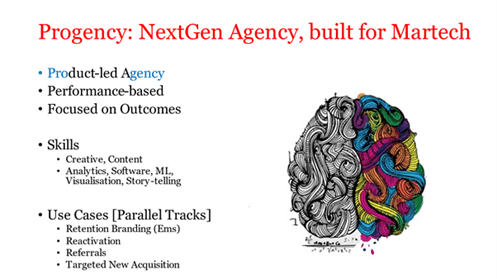
Progency is an agency built on top of a Martech 2.0 product platform; it is a product-led agency. It combines platform, people, and process into a unified offering priced on performance. It makes martech as simple as adtech is: identify a goal and outsource it to an agency. In this case, the agency is powered by tech. As I wrote previously: “The progency is actually a very scalable tech powerhouse with the full stack martech platform as the machine. Brands can either buy the machine itself (in effect, rent a version of it, since it’s all delivered from the cloud) or hire the machine developer to deliver the outcomes… Its pitch is simple: we will deliver the outcomes you need, we will get the job done for you. We have the machine and the operators. No one knows the machine better than we do. We constantly make the machine better. You don’t need to worry how it works. (No marketer knows how the targeting machines of Google and Facebook work.) You can of course buy the drill, but we are here to give you the hole that you really desire. You pay based on the performance, so we are on the same side.”

**

We are now ready to drill down and construct the marketer’s map with its three stations: pipe, partitioning, and prospecting.

Thinks 467

Donald Boudreaux: “My George Mason University colleague James Buchanan won the 1986 Nobel Prize in economics in part for his work explaining why it’s mistaken to conclude that internally held debt imposes no (or only minuscule) burdens on the economy. Buchanan reasoned that the burden of the debt isn’t borne by the lenders: They lend voluntarily in hopes of receiving an attractive return. Had they not loaned to the government, they would have used their money in other ways, likely as loans to private investors. Nor is the burden of the debt borne by today’s taxpayers. It’s precisely to avoid raising taxes today — to avoid burdening today’s taxpayers — that government borrows. The burden of the debt falls just where common sense tells us it falls: on the people whose taxes are raised to pay it. Those people are taxpayers in the future.”

Bruce Bueno de Mesquita: “Why Europe became distinct after the year 1000 and not before can be reduced to this surprisingly simple reason: in Europe, the head of religion and the head(s) of state were different people who faced off against one another in long-standing, long-lasting, intense competition for political control. Certainly, the rulers of China and Japan were thought to be gods.” [via Tyler Cowen]

Dan Shipper: “In creative work there are two phases: exploration and execution. In the exploration phase, you don’t know what the thing is going to be, you don’t have all of the information or ideas you want to have, you don’t even know if what you’re thinking about is important, and any little breeze in the wrong direction might blow you off course. In the execution phase, you are inspired, you know what the thing is, you know how to make it, it feels urgent; all you need to do is sit down and do the thing. Execution is Elton John writing Your Song in 20 minutes. Exploration is everything that happened before that.”

Martech 2.0 and Web3: Solving Advertising’s 50% Problem (Part 9)

Marketer’s New Map

We are now ready to chart out a new roadmap for the marketer for cutting back out-of-control adtech spending by eliminating the 50% waste going into reacquisition and wrong acquisition. The big insight that a marketer needs is that the starting point is not focusing on optimising the adtech spend but to begin with the existing customer base. With only a tenth of marketing budgets being invested on building relationships with existing customers, it is little surprise that marketers are unable to maximise customer lifetime value and control churn. Pivoting to a martech-led strategy is the only way to pull back adtech budgets feeding the growing CAC (customer acquisition costs) monster.

The map has three stations en route its destination to exponential forever profitable growth: pipe, partitioning, and prospecting. Pipe is about solving the attention recession problem with existing customers. Only with an alert and active customer base can marketers persuade them with their messages. Partitioning is about segmenting the customer base into three: Best, Rest and Test customers. Best customers need a separate SBU focused on providing differentiated experiences since they are the ones who will deliver the profits. Test customers are the in actives, and need to be outsourced to a Progency for reactivation. The in-between segment of Rest customers is where business-as-usual marketing needs to be done to nudge them in their purchase journey towards the next best action. Prospecting is about the Next customers. This is where two ideas not being currently leveraged come into: an improved referrals program which persuades Best customers to open up their network of family and friends, and an adtech-martech bridge that targets the right set of customers based on the genome of Best customers.

This is a new map for marketers. Very little of this is being done today. In most brands, the pipe is non-existent because a very large percentage of brand messages are being ignored. Lack of attention results in a break in the brand-customer relationship because there is no other way to bring existing customers back to the properties (web and app) other than huge investments in branding. Partitioning is being done on trivial attributes rather than customer lifetime value. Without CLV, marketers are unable to correctly identify who the brand’s Best customers are. The experience thus becomes commoditised for all, and the high and loyal spenders tend to drift away because they are also the ones constantly being targeted by competition with attractive offers to switch. Also, the dormant customers are not being reactivated and instead end up being retargeted for new acquisition at many times the cost via the adtech platforms. Prospecting is being done in a vacuum, in many cases by an independent team that doesn’t talk to the martech team to understand the attributes of Best customers. Also, referral programs are non-existent in most brands.

Adtech and martech are both broken. Only by changing the starting point to martech can brands embark on a new journey. As Einstein said, “Insanity is doing the same thing over and over and expecting different results.” It is time for marketers to end the adtech spending insanity by embracing three innovations that we have discussed: Atomic Rewards (in the form of Web3 crypto tokens), Martech 2.0 stack, and Progency.

Thinks 466

Atanu Dey: “We have to  distinguish between three distinct measures related to material prosperity: wealth, income and consumption. Wealth is a stock while income and consumption are flows. They are generally correlated but not perfectly so. A person with immense wealth may choose a level of consumption similar to a person with a modest income. Warren Buffett’s wealth is massive compared to that of a successful lawyer’s but their consumption would be quite similar. Basic point: we should be concerned about the consumption of the poor, and should be less concerned about the wealth of the super-wealthy. I don’t care how much wealth Bezos has; what I care about is whether a child is malnourished.”

Ray Dalio: “History has repeatedly shown that people tend to have a strong bias to believe that the future will look like a modestly modified version of the past even when the evidence and common sense point toward big changes. I believe that’s what’s going on and that we are in the part of the cycle when most people’s psychology and actions are shifting from deeply imbued disinflationary ones to inflationary ones. For example, people are just beginning to transition from measuring how rich they are by how much “nominal” (i.e., not inflation-adjusted) money and wealth they have to realizing that how rich they are should be measured in “real” (i.e., inflation-adjusted) money and wealth. From studying history, and with a bit of common sense, we know that when people shift their perceptions in that way, they change their investment and non-investment behaviors in ways that produce more inflation and that make central banks’ difficulties in balancing inflation and growth harder.”

Are We Measuring Our Lives in All the Wrong Ways? The philosopher C. Thi Nguyen believes that to understand modern life, we need to understand how games work.

Martech 2.0 and Web3: Solving Advertising’s 50% Problem (Part 8)

References

Each of the ideas mentioned has been independently covered in my earlier writings and a few talks. (What was missing was a framework to unite them together to solve the larger problem of spiralling adtech spends – which is what this series does.) The ones in bold are good starting points.