Rethinking Referral Marketing (Part 4)

Before we answer the question of what we can do better with referral marketing, we need to first understand the present state of the programs. I spent an afternoon reading dozens of articles that have been published over the past few years.

At  a broader level, word-of-mouth marketing has many elements, as Amity Kapadia explains:

  • Referral Marketing: Exactly what it sounds like — a strategy for encouraging passionate customers and advocates to directly refer their network to your business.

  • Affiliate Marketing: A transaction between a company and an entity where the business receives customers (or leads) in exchange for a financial incentive.

  • Influencer Marketing: In many ways influencer marketing is a modern take on traditional affiliate marketing. Instead of a network of smaller affiliates driving traffic, however, influencer marketing targets specific people who have large, captive followings.

  • Partner Marketing: Very simply, partner marketing is a strategy that aims to connect two brands to share one or both brands with the other’s networks. Primarily used in B2B marketing plans, this strategy strives to raise and improve brand awareness amongst similar audiences.

We will focus on referral marketing in this series. There is a good overview of referral marketing from Wikipedia:

Referral marketing is a process to encourage and significantly increase referrals from word of mouth, perhaps the oldest and most trusted marketing strategy. This can be accomplished by encouraging and rewarding customers, and a wide variety of other contacts, to recommend products and services from consumer and B2B brands, both online and offline.

Online referral marketing is the internet-based, or Software as a Service (SaaS) approach, to traditional referral marketing. By tracking customer behavior online through the use of web browser cookies and similar technology, online referral marketing can potentially increase brand awareness, referrals and, ultimately, revenue. Many platforms allow organizations to see their referral marketing return on investment (ROI), and to optimize their campaigns to improve results. Many of the newest systems provide users with the same experience whether they are on a desktop or mobile device. Offline referral marketers sometimes use trackable business cards. Trackable business cards typically contain QR codes linking them to online content for sale while providing a way to track that sale back to the person whose card was scanned.

Online referral marketing focuses on interactions between customers. The Internet is a common channel for referral-based marketing. It delivers abundant outlets for customers to share their opinions, product favourites, and experiences, including the company’s website and through social media such as LinkedIn, Facebook, Twitter, and Google. The marketers can encourage the referring parties by providing pre-scripted messages. Advocates can provide their family members and friends with personalised links including unique referral codes and advertisement information through e-mails, blogs and instant messages. The company can give rewards to advocates when their family members and friends buy through the link.

Tomorrow: Rethinking Referral Marketing (Part 5)

Rethinking Referral Marketing (Part 3)

I started thinking about my own experience as a customer of many brands. I could not recollect a single instance of a brand pro-actively asking me to recommend others who could become customers. Yes, there would be some link in the app which would give me a referral code or link to send to others. But that didn’t really seem anything exciting. None of the referral programs seemed interesting enough for me to actually talk to others.

And yet I would talk to others about new products that I bought and liked. A case in point was this Yeti Blue microphone that I bought after being attracted by the lovely clickbait headline from a Wall Street Journal article, “How to Sound Your Best on Calls From Home?” I was so thrilled with how my voice quality improved (to others) that I would immediately show them the secret – my new microphone. Not surprisingly, at least five others bought the same microphone! I did all this on my own – unknown to Yeti, and with no financial incentive for myself.

As I thought about my own buying and recommending behaviour, I realised that I do get influenced by what those close to me recommend. It could be books, movies, restaurants or even vacations. Word-of-mouth marketing is a key factor in many of our purchase decisions. And yet the world of referral marketing (like that of loyalty programs) has largely stayed the same through the years.

Few brands that have a relationship with me (and many don’t) actually have reached out to ask me whether I would recommend them to people I know. Perhaps, I would not – there is always a social awkwardness in doing so. And yet, we do it quite often. As a result, referral programs tend to have a one-size-fits-all approach for the lowest common denominator. That’s where I felt they were all making a big mistake – by not creating a program for their best customers, they were missing out on an amazing acquisition opportunity. So, how could it be done better?

Tomorrow: Rethinking Referral Marketing (Part 4)

Rethinking Referral Marketing (Part 2)

As I started to think about the new customer acquisition problem, my first answers were:

  • Identify who your best customers are
  • Decode the genome of these best customers
  • Use the Best Customer Genome (BCG) to run lookalike campaigns for new customers

I should mention another point in passing. A brand’s best customers could also be persuaded to get others like them – given that each of us has a wide social network, and we do tend to advocate brands we like to our family and friends. Word-of-mouth has a big influence on what we buy.

I never thought of this seriously until the same question got asked in three successive meetings. In fact, one of the CMOs put it in straight-forward terms: “I don’t want to spend a lot running Google/Facebook ads for new customer acquisition. I have X million happy customers. How can I get them to get me more like them?”

What the CMO was alluding to was referral marketing. (It is also called word-of-mouth marketing, but I will stick to referral marketing in this series.) That got me thinking about the problem more deeply. One angle especially struck me – how to persuade the best customers to do referral marketing? The best customers are very likely to know and refer more like them – which means it can become a very powerful positive feedback loop for revenue growth for a brand.

The problem seemed very similar to the loyalty programs that brands run. Most brands have a loyalty program, but few have transitioned to making it into a VRM program which creates a differentiated experience for their best customers. Referral programs also seemed to be stuck in a similar time wrap – if they existed. A free ride here, a few points there, and that’s it.

Were brands missing out on a big opportunity by not combining the two ideas of best customers and referral marketing? If so, what could they do?

Tomorrow: Rethinking Referral Marketing (Part 3)

Rethinking Referral Marketing (Part 1)

The past few months have given me a lot of time to think deeply about marketing. Starting with the ideas of Velvet Rope Marketing (VRM), I have had dozens of conversations with CMOs and digital heads of brands in India, SE Asia, Middle East and Africa. The basic problem statements are the same: how to get more from the existing customer base and how to optimise new customer acquisition.

In this context, the VRM pitch works well:

  • All customers are not equal; some have more customer lifetime value (CLV) than others
  • Identify your best customers – say, the top 20% — based on CLV
  • Create a differentiated experience for these customers to maximise revenue and retention
  • Among the rest, use individual customer genomes to identify who could be future best customers
  • Also use the characteristics of best customers to acquire new customers who look like them

On paper, this looks simple. But it is quite surprising how few companies actually do this in a disciplined manner.

I have identified eight problems that handicap the use of VRM:

  • Limited data: Brands are not collecting customer data at every touchpoint
  • No CRM / CDP: The collected data is not centralised into a single place to provide a unified customer view
  • Data not being analysed: If the data is there, then the analysis is either not being done or is very limited
  • No internal team / skillsets: The right talent is missing for doing the analytics and then acting on it
  • Incorrect CLV calculations: Too often, the CLV calculations are done in a very simplistic manner (for example, basing it on the average value of past transactions)
  • No tech platform: Even if all the above is done, there is no tech platform to help implement the use cases
  • Adtech-Martech silos: The acquisition process is not streamlined because there is no exchange of data between the acquisition and engagement teams
  • Cannot measure RoI: Finally, it is hard to get the green light for VRM because the CMO is unable to show the actual uplift in revenue

In my presentation, I address each of these challenges and show the solution to every identified problem. These series of essays discuss the VRM roadmap in depth:

And as it happens so often, one idea leads to another. While VRM does well in addressing the needs of the best customers, a question that came up repeatedly in my meetings was about how to optimise new customer acquisition.

Tomorrow: Rethinking Referral Marketing (Part 2)

Podcast on Velvet Rope Marketing

I recorded a podcast with Dennis Dayman as part of the “Email Unplugged” series driven by our US team.

We discuss my early entrepreneurial journey, and then go deeper into VRM:

  • What is Velvet Rope Marketing all about?
  • How can businesses implement VRM during a crisis?
  • How to identify your best customers and communicate with them effectively
  • How to cut down marketing costs with VRM
  • The importance of full-stack automation platform to leverage VRM
  • How VRM can help you acquire new customers
  • Special tips to optimise your email campaigns with VRM

Announcing: hippoBrain

Along with Jaimit Doshi, I have launched a new show — hippoBrain. As we put it, it is about “hippo-sized conversations with hippo-sized brains.” The focus will be largely around data, tech and the consumer.

The idea came a couple months ago. While there is a lot of content out there, what I find missing is deep conversations with people — to really understand their mental models and how they think. In today’s attention-deficit world, everyone is looking for that 30-second sound byte. But what is missing is the context around that. Why does the person think in that way? That’s what we want to do with hippoBrain — give an insight into how the guest on our show think.

We have launched with 3 amazing guests: Vivek Bhargava (Denstu;  ad-tech authority), Kartik Jain (DBS, ex-HDFC Bank; marketing maestro) and Anindya Ghose (NYU Stern; mobility and AI guru). We will have one new hippoBrain episode every Friday.


The One Number To Predict Revenue (Part 10)

What can you do as a business leader? Here are the 7 steps to getting started with the ideas and apply the ideas of NPR in your business:

  1. The starting point is transaction data. Collate customer-wise transaction data for the past few years.
  2. Calculate Customer Lifetime Value (CLV) for these customers. Remember that CLV mentioned here is predictive and forward-looking.
  3. Plot the CLV-Customers chart and see the power law at work
  4. Based on this, you can calculate the Predicted Revenue – the aggregate CLV for all present customers
  5. By factoring in loss of revenues due to expected churn and additional revenue via new customer acquisition, you can get the Net Predicted Revenue (NPR)
  6. The next step is to apply the ideas of Velvet Rope Marketing (VRM) to grow revenue from the Best Customers, get some of the Rest and Test Customers to become the Best, and acquire Next Best Customers who are likely to have a higher CLV (see graphic below)

  1. Set up a process by which the CLV and NPR calculations are automated and available periodically to all decision-makers.

Through these actions, you can now view in near real-time the impact of the marketing activities on a forward-looking basis through the lens of customer actions. NPR should thus become the single business number to discuss strategy and drive new initiatives.

These are ideas which can be applied to every business in every industry. By calculating NPR across time, one can see the impact of customer-centric initiatives. NPR thus allows vendors to become partners because the impact of each action can be measured, and thus gainshare models can be applied to customer acquisition, retention and development. For the first time, business leaders can get a measurable marker for future profit growth. The CLV-VRM-NPR triad is the path for every business leader to rise to the most important position in today’s challenging times – becoming the CPO (Chief Profitability Officer).

The One Number To Predict Revenue (Part 9)

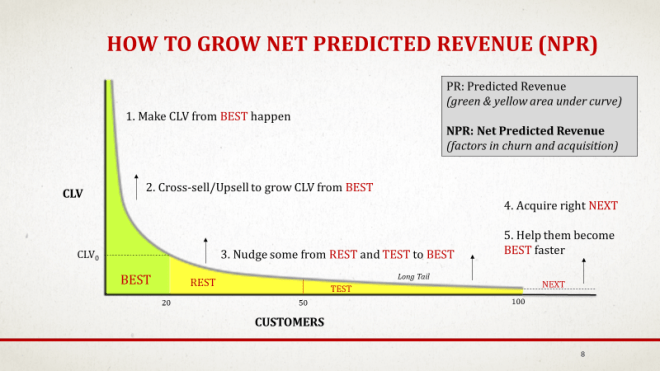
This single chart brings together the ideas of Velvet Rope Marketing and Net Predicted Revenue.

Once the CLV for all customers has been calculated, we get the Predicted Revenue for all present customers. This is indicated by the green and yellow areas under the curve. (Best Customers are the top 20% customers with a CLV greater than CLV0, while the middle 30% customers have been labelled Rest and the bottom 50% as Test.)

Marketing’s objective is simple: grow the area under the curve. This is what VRM does and NPR measures.

There are 5 actions that marketing needs to do:

  1. Make CLV from the Best happen: this is the core of VRM – how to provide amazing experiences to the Best Customers so they do not churn. At a minimum, the projected CLV is what must be realised.
  2. Cross-sell/Upsell to grow CLV from the Best: this is about increasing the green area by pushing the curve higher. This is where a good understanding of the customer genome combined with a martech platform to implement VRM can help create what we can think of as “100% customers” – where a brand monopolises the complete spending of the customer in a category.
  3. Nudge some from Rest and Test to Best: this can be done by analysing the Best Customer Genome, identifying the next best action for each customer, and creating the future pipeline of new Best Customers to replace some who will inevitably churn.
  4. Acquire right Next: this is about using information about Best Customers to acquire lookalikes so that the wastage that is ever-present in new customer acquisition can be reduced
  5. Help them become Best faster: this is about providing a super onboarding process for likely Best Customers to ensure they can cross the CLV0 spending threshold sooner than later

Tomorrow: The One Number To Predict Revenue (Part 10)

The One Number To Predict Revenue (Part 8)

To better understand how NPR can be applied, a business can start by charting the CLV for each customer.

Next, sort the customers by CLV from high to low on the X-axis.

And what do we see? A curve which looks like the power law!

We can then segment the customers into Best-Rest-Test.

Marketers and business owners can then get to work on the customers to grow the CLV. In the graph below, the brown area shows how the predictive CLV changes for some customers leading to an increase in the area (which is the predicted revenue).

In this case, what has not been factored in is churn and new customer acquisition. Also, the customer acquisition costs (CAC) have been ignored.

These charts show how the CLV calculation can help in predicting revenue. Business leaders can now get a forward-looking impact of their present-day customer-centric initiatives. Given that costs are more directly under the control of the leaders, Net Predicted Revenue (NPR) is the one number that can thus be used to predict revenue – and perhaps profits.

Tomorrow: The One Number To Predict Revenue (Part 9)

The One Number To Predict Revenue (Part 7)

NPR as we have discussed is a bottom-up way of predicting future revenues. It starts with the actions of a single customer. Will that customer stay? Will that customer spend? Will that customer churn? Past actions as computed through an RFM (recency frequency monetary value) grid help compute the probabilities for what a single customer will do.

What is important here is the focus on a single customer. There is an equivalent idea in economics that is focused on a single individual as the unit of analysis – the concept of “methodological individualism.” Here is an explanation from The Encyclopedia of Libertarianism:

According to Ludwig von Mises, methodological individualism views “all actions [as] performed by individuals”—or, in the words of Karl Popper, that social phenomena “should always be understood as resulting from the decisions, actions, attitudes, etc., of human individuals, and that we should never be satisfied by an explanation in terms of so-called ‘collectives’ (states, nations, races, etc.).”

So, even as we think about customers as the collective, it is the single customer that should serve as the basis of analysis and action. The idea of CLV assigns a future revenue value to each individual customer. It is a bottom-up model, rather than just top-down extrapolation. It is forward-looking and predictive, rather than taking a number from the past.

In the real world, customers are masters of their own preferences. As such, they can continue with a brand or they can switch to another brand to get their job done. One brand’s churn is another brand’s acquisition. By starting with predicted revenue and layering churn and acquisition, it is possible to arrive at Net Predicted Revenue (NPR).

This becomes the most important metric for a marketer – change in NPR over a period of time will help provide early indications of the future health of a business. It is a lead indicator, a crystal ball into the future. NPR is the single magic number that CEOs who think profitability (rather than chase valuations) should be focused on.

Tomorrow: The One Number To Predict Revenue (Part 8)