I did a webinar on Velvet Rope Marketing last week. You can watch the video here. (If viewing on a mobile, please scroll down past the form for the video.)
I speak for the first 35 minutes, and then answer questions for the next 25 minutes.
I did a webinar on Velvet Rope Marketing last week. You can watch the video here. (If viewing on a mobile, please scroll down past the form for the video.)
I speak for the first 35 minutes, and then answer questions for the next 25 minutes.
Dipali Banka from Impact magazine interviewed me about martech, entrepreneurship and Netcore. From the intro: “Rajesh Jain’s idea of creating differentiated experiences for your best customers through ‘Velvet Rope Marketing’ and creating ‘Proficorns’ rather than ‘Unicorns’ are concepts that companies can adopt in these difficult and uncertain times to ensure a profitable business. The Founder & Managing Director of Netcore Solutions is clear that this is the best time for a CMO to adapt and become a Chief Profitability Officer using marketing technologies on the existing customer base.”
A few excerpts from what I said:
Here is the interview on pages 18-19 of the magazine.
There is also a video of the interview.
We are now in a position to see how Velvet Rope Marketing (VRM) can help enterprises double their profits with the twin engines of increasing revenue from Best Customers and decreasing acquisition costs. Think of this as the instantiation of the 200-20 rule that Sunil Gupta had talked about – for 200% profits, focus on 20% of the customers, grow revenues by 20% and reduce media spends by 20%.

The table below summarises the approach that smart marketers should take in this quest to double profits:

The greatest impact can be made by shifting focus from the middle cohort to the Best Customers. Creativity needs to go in crafting the VRM programme – what non-cash experiences can be created that will make the brand’s Best Customers feel like royalty – so that they spend more, stay longer and spread wider.
The foundation can be laid by rebuilding the marketing stack centred around these six elements:
The growth of devices, acceleration of digital and availability of data makes it possible to treat customers differently and recognise that some are more equal than others. Velvet Rope Marketing is the perfect business transformation idea – for today and forever.
A postscript for CMOs: While everyone else in the organisation is focused on cutting costs and conserving cash, Velvet Rope Marketing is the magic sauce that can transform you into profit doublers – the Chief Profitability Officer!
The focus on Best Customers (identified by CLV) can also reduce advertising and customer acquisition costs. This is done by combining martech with adtech – ‘madtech’ as it has been termed.

The big idea is about using information about Best Customers (their demographics and behaviours) to prospect for more like them. Instead of scattering marketing budgets to acquire all kinds of customers, the smart marketers will use information from VRM to optimise their ad spends to acquire mirror images (‘lookalikes’) of their Best Customers. Given that ad budgets tend to be a large component of the overall costs of an enterprise, optimising media spends on customer acquisition can help increase profits.
The adtech-martech integration can yield two additional benefits:
The full power of the integration between adtech and martech manifests itself across the customer journey as seen below to create a very powerful VRM flywheel:

Tomorrow: Velvet Rope Marketing (Part 7)
Best Customers can beget more Best Customers. They are valuable not just by themselves, but also for who they can bring in. They can become amplifiers of good experiences – what has been called “word of mouth.” With social media, this gets magnified even more – each of us today can reach hundreds through our posts on Whatsapp, Instagram, Tiktok, Facebook and LinkedIn. Best Customers can thus have a multiplier effect via their advocacy on social media platforms – something that was much harder to do in the past when the direct reach each of us had was limited.
By becoming advocates of the brands they love (both for the product and their experience), Best Customers can thus get more lookalikes into the fold – each of whom has a higher probability of being a future Best Customer. As a result, it becomes possible to grow revenues substantially on account of the Best Customers.
As my Netcore colleague Chaitanya Chinta explains:
Some brands carry an emotional identity with users and when connected effectively creates “Brand Fans” … like Apple, Starbucks, Under Armour, etc. These brand fans are usually powerful. For any commercial brand, identification and activation of these brand fans is essential for its short-term and long-term success. This is even more important in the coming few months due to Covid.
In fact, fans of any brand are the most engaged and profitable customers – Best Customers in the VRM Model. They are usually about 15-20% of the user base that the brand has, but contribute a significant portion of revenue.
The beauty of VRM is that it identifies and activates (via martech) their fandom – making them more attentive towards brands content, more likely to transact, share positive experiences and ultimately, influence others. That’s the bliss point for any brand.
This is exactly what brands like Google, Apple or any brand with a cult-like culture does. They identify and activate fans …and pull in more people into “fan club” using activated fans.
If a brand aspires to have a cult-like following (and more revenues and profits), it needs VRM.
Best Customers thus become magnets and super-spreaders, attracting others like them. This is another big reason to deploy Velvet Rope Marketing for the top 20% customers.
Tomorrow: Velvet Rope Marketing (Part 6)
Marketing has largely been targeted to the median customer – not much differentiation being done in targeting different customers. Median Targeting (or Marketing) works very well in politics – where every voter has the same power (a single vote). But in marketing, the same approach does not necessarily deliver the right returns – since the Best Customers can deliver many times the value of the median customer.
The table below highlights the differences between customer segments and shows the importance in revenue (and consequently, profits) of the top 20% – the Best Customers. Loyalty is the keyword and Velvet Rope Marketing fosters exactly that.

Customer Lifetime Value (CLV) helps separate customers into the three buckets. As should be obvious by now, CLV distribution is not a bell curve (normal distribution) but one with an exponential decay, as this image from a Zodiac and Infotrust Webinar shows:
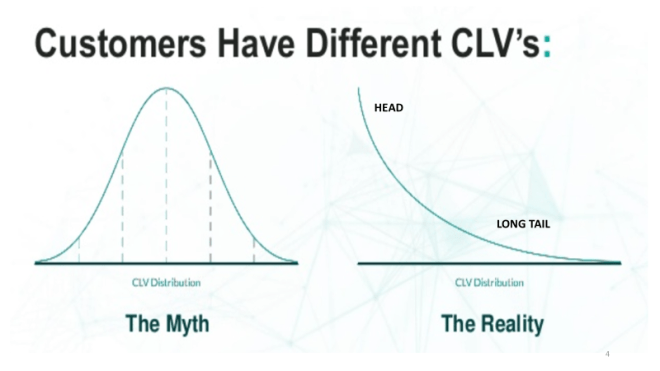
Best Customers constitute the “head”, with the bottom 50% constituting the “long tail.” Yet, most marketers are obsessed with the Median Marketing approach. For one, it is easy to do. Offers for all, campaigns for all, same website for all, same app experience for all, churn reduction for all, and so on. It is communism applied to marketing!
What smart marketers do is to think capitalism. There is inequality – and that’s a good thing. In an economy, what matters is not the quantum of inequality but the income of the poorest. Being poor in a rich country can still deliver a decent lifestyle. In marketing, what matters is the spends and profits from the Best Customers. Their CLV is what should be maximised. This is what Velvet Rope Marketing does. It is capitalism applied to marketing.
Tomorrow: Velvet Rope Marketing (Part 5)
The key to identifying Best Customers for Velvet Rope Marketing (VRM) is in identifying their Customer Lifetime Value (CLV). As Peter Fader explains in his book, “Customer Centricity”:
Customer Lifetime Value (CLV) is a forward-looking, predictive measurement that is calculated by modelling and projecting the following:

There are many other benefits of using CLV:
Here are three things you can do to get started:
In a nutshell: VRM is about making choices. Companies should not try to treat every customer the same. They should create an amazing experience for their Best Customers who are likely to contribute to a majority of the revenue and a disproportionately large share of profits. In times when hard choices will be required of marketers and enterprises, VRM can be the answer to retaining the right customers and growing profits.
Tomorrow: Velvet Rope Marketing (Part 4)
Velvet Rope Marketing (VRM) is much more than a loyalty program. In a loyalty program, anyone can sign-up and collect points. In a VRM program, it is the brand that decides which customers are eligible for the differentiated experience. Many companies have a loyalty program, but very few do VRM. By missing out on deepening relationships with their best customers, they are losing out on opportunities to increase their profits – because Best Customers can be many times more valuable than the median customers.

So, what can companies do for their Best Customers? Here are a few examples:
Another way to think is along the three dimensions of Exclusivity, Envy and Access – as outlined in the book “The Velvet Rope Economy”. Here are some more examples of differentiated service examples:
Exclusivity
Ease
Access
Which brings us to the key question: how does one identify Best Customers?
Tomorrow: Velvet Rope Marketing (Part 3)
Over the next year or two, companies are going to see profits under pressure, marketing budgets getting minimised and capital being constrained. At the same time, business needs to continue. What can enterprises do to strengthen their market positions given these limitations? The answer: Velvet Rope Marketing.

I recently read Sunil Gupta’s book, “Driving Digital Strategy.” There was one idea that stood out (among the many excellent ones in the book): the 200-20 Rule. Here is what he writes: “According to the familiar 80-20 rule, 20 percent of the customers provide 80 percent of the revenue. However, research shows that if we focus on profitability instead of revenues, the rule would be 200-20, where 20 percent of the customers provide almost 200 percent of the profit! How is that possible? Because the remaining 80 percent of customers actually destroy profitability.”
I have also been thinking about another related idea outlined by Peter Fader in his two books on customer centricity – that of focusing on best customers to maximise profits. A few quotes from his books:
Building on the concepts outlined and through conversations with marketers, I came up with the idea of “Velvet Rope Marketing” (VRM) – focus on creating a differentiated experience for the Best Customers as identified by customer lifetime value (CLV) to maximise profits. Best Customers sign-up early, stay longer, spend more, spread wider and are serviced easier.
For these customers, companies need to roll out the “velvet rope” experience to treat them like royalty. We have seen the velvet rope (with the red carpet) at airline first class and business class check-in counters, and at the exclusive entrances at Disneyland. It creates exclusivity, envy and a feeling of being special. VRM can help generate additional revenues, higher profits, loyalty and word-of-mouth.
Tomorrow: Velvet Rope Marketing (Part 2)
I did a webinar for Royzz & Co. (a Mumbai-based law firm) on April 18, 2020. The title was: “Accelerating Beyond COVID – 19: India, AI and Acquisitions“. I spoke for about 30 minutes, and then there was about 35 minutes of Q&A. Here is an outline of the themes that I covered.