My Proficorn Way (Part 64)

Mountains beyond Mountains

This is a phrase I use often in conversations to describe the series of challenges an entrepreneur faces when building a business. I first came across this phrase many years ago. It was the title of a book by Tracy Kidder on the life of Paul Farmer. One of Tracy Kidder’s previous books, “The Soul of a New Machine”, had won a Pulitzer Prize. The book, published in 1981, told the story of a team at Data General that was building a next-generation computer. “Mountains beyond Mountains” was published in 2003. It chronicles the life of Farmer, who was fighting tuberculosis in Haiti and other countries. The title comes from a Haitian proverb: “Beyond mountains, there are mountains.” It means that as you solve one problem, another will present itself.

From an enotes answer on the book’s title: “The mountains could metaphorically represent obstacles, and this proverb could be read in a negative way to mean that there are always more obstacles in your way. However, it’s also possible to read the proverb in a more positive light if we interpret the mountains to metaphorically represent opportunities. A mountain, after all, represents an opportunity for self-betterment and an opportunity to achieve something significant by reaching the summit. Reaching the summit, or overcoming the problem, is a cause for celebration.” Another answer adds: “The proverb gives us the sense that as soon as an obstacle is overcome or a problem is solved, another one is waiting.”

The life of an entrepreneur is very much that of climbing one mountain only to see another higher one waiting. The second mountain was perhaps obscured by the mountain in the front, so it only comes into sight after the first has been climbed. And so it goes. One problem after another, one challenge after another. Day after day.

Building a business is not like walking down a straight road. Climbing a mountain requires courage, determination and stamina – and some luck. One misstep and the consequences could be disastrous – getting lost, a fall, or even death (failure).  The journey is never finished – because once one problem has been solved, another one awaits to be tackled.

So, why do entrepreneurs do it? Why do they stake it all for the hard life? For the entrepreneur, it is not always about money. Of course, the financial rewards are an important motivator. But there is much more. Just like Paul Farmer dedicated his life to conquering disease and making the world a better place, so too does the entrepreneur – risking everything to improve something seen as inefficient. It is this belief that things can be made better that provides the energy to wake up every morning and climb higher, fall a little, and start all over again. And once one peak has been reached, it is onward to the next one. Mountains beyond Mountains.

Tomorrow: Part 65

Thinks 19

Tim Berners-Lee’s next (from NY Times): “The idea is that each person could control his or her own data — websites visited, credit card purchases, workout routines, music streamed — in an individual data safe, typically a sliver of server space. Companies could gain access to a person’s data, with permission, through a secure link for a specific task like processing a loan application or delivering a personalized ad. They could link to and use personal information selectively, but not store it.”

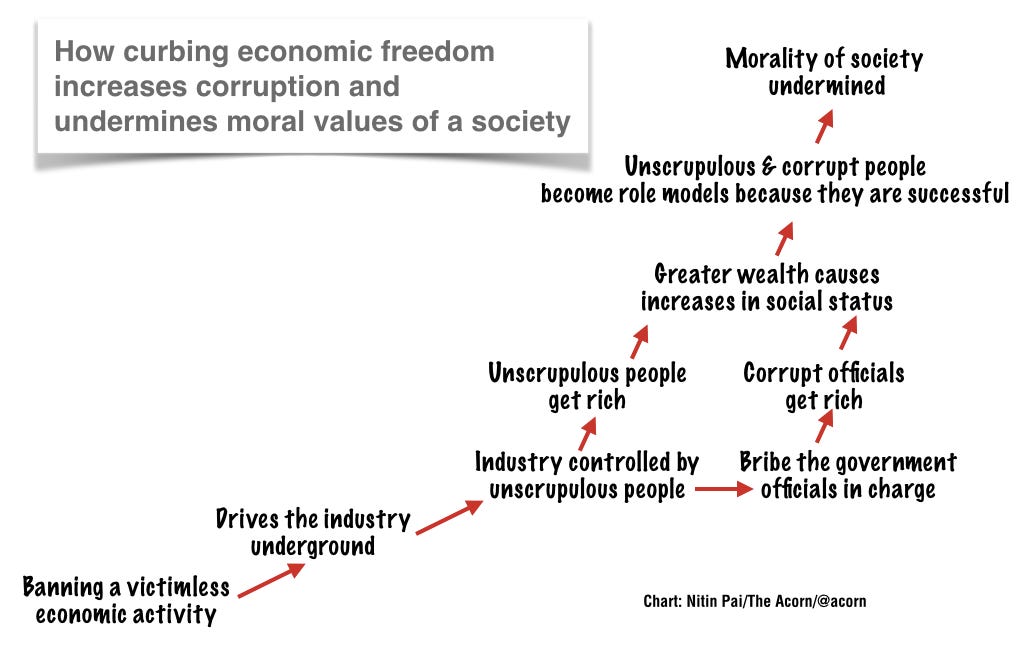
From Nitin Pai (via Anticipate the Unintended newsletter):

https://cdn.substack.com/image/fetch/f_auto,q_auto:good,fl_progressive:steep/https%3A%2F%2Fbucketeer-e05bbc84-baa3-437e-9518-adb32be77984.s3.amazonaws.com%2Fpublic%2Fimages%2F4f6460f6-e893-490b-9d0e-754091b3394f_1018x648.png

Milton Friedman: “We will not solve our problem by electing the right people. We will only solve our problem by making it politically profitable for the wrong people to do the right thing.” (via Atanu Dey)

My Proficorn Way (Part 63)

Where to Invest

Bijal, a colleague at Netcore, pointed me to a question asked on Twitter by Paras Chopra (founder of Wingify): “If you were the founder of a bootstrapped company with enough money to invest into business, how would you invest it such that your VC funded competitors will not be able to do replicate?” Bijal wanted to know my views on the question.

My initial reaction was: “Business is not like physics or maths! Answers differ for everyone, and every business. Every company has to make its own choice. Some can invest in new experiments, some in buyback, some in acquisitions… And at times you have to just save for a rainy day also — like a Covid-type situation.” And as Paras clarified: “The point is to do something different that turns out to be valuable.”

I then read some of the replies on the Tweet thread:

  • There isn’t that much difference between money, but I guess one big difference is that bootstrapped companies can diversify more? VC money is typically used to double down on what you already have.
  • This means the investment will have to be something VCs would never sign off on. Maybe a second profit center, or a community
  • Be insanely patient and think in years/decades and not days/weeks/months. Most VC funded competitors are not encouraged nor incentivized to think in years.
  • Invest in things that money cannot quickly scale. Like a good SEO based strategy. A good white hat campaign cannot be replicated with VC money, while Ads can scale, Sales can be scaled. Eg: Canva, Freshbooks
  • Investing in experiments in markets where there is no consensus about “massiveness of the market”. Ex – 40+ internet users in India, teens in India, pet owners in India, home gardening in India etc. VC’s never invest without conviction on market size.
  • Find the right people for the right Hard to compete in Money, but can make a difference in choosing people.
  • I wouldn’t worry about VC funded competitors. I would focus on the founders, their vision, the problem and the market and will decide based on that and will try to help the founders to succeed.
  • Sharp focus on capital allocation…and hence prioritise on what enhances the moat around your business. Capital allocation is a skill that founders of bootstrapped companies need to acquire/get help with vs VC funded competition.
  • Do things where capital isn’t the primary moat / irrespective of capital that aspect takes time to build. Some egs : in B2C -> SEO, in B2B -> strong founder level relationships with the largest clients (assuming capital = strong tech)
  • Chase profits and growth at the same time, not just growth singularly. That’s a lot more valuable than just burning truckloads of cash and then raising more and more to sustain/further grow the biz
  • Invest in companies in adjacent domains which help you create a MOAT to keep and protect your business forever.

Interesting answers. As I thought more about the question, I came to another conclusion. In today’s world, growth and scale are both important. A single company cannot solve every problem. There will always be startups doing interesting things faster than a larger company can. What a profitable company can do is to do an IPO and get listed on the exchanges – because this does two things. First, it provides currency for acquisitions. Second, it provides liquidity to employees. Both are critical for the proficorn to maintain an edge. Private companies end up having to pay in cash for acquisitions if no benchmark valuation has been set.

So, as a bootstrapped company, the aim should be to achieve scale to do a listing which then provides the capital and currency for accelerating growth via acquisitions (and also bringing on more talent). There will always be many startups (VC-funded or bootstrapped) who will be looking for an exit. Acquiring and integrating them rapidly can provide a powerful playbook for even more profitable growth.

Tomorrow: Part 64

Thinks 18

The Economist on a new era of innovation: “There are three reasons to think this “great stagnation” might be ending. First is the flurry of recent discoveries with transformative potential. The second reason for optimism is booming investment in technology. The third source of cheer is the rapid adoption of new technologies.”

Internet 3.0 and the Beginning of (Tech) History: “Here technology itself will return to the forefront: if the priority for an increasing number of citizens, companies, and countries is to escape centralization, then the answer will not be competing centralized entities, but rather a return to open protocols.” By Ben Thompson.

Watched: Tandav on Amazon Prime Video. Very well made series. But it fell away in the final episodes.

My Proficorn Way (Part 62)

The Rule of 100

A few years ago, I came across the Rule of 40 – the principle that for a software company, it’s revenue growth rate and profit margin should exceed 40%. Here is what it means in practice:

  • If a business is growing at 100%, it can have a profit margin of -60%
  • If a business is growing at 60%, the profit margin can be -20%
  • If a business is growing at 20%, the profit margin should be +20%

Bain has more on the Rule of 40:

The Rule of 40…has gained momentum as a high-level gauge of performance for software businesses in recent years, especially in the realms of venture capital and growth equity. Increasingly, software industry executives are embracing the Rule of 40 as an important metric to help measure the trade-offs of balancing growth and profitability.

Software companies that can balance growth and profitability to outperform the Rule of 40 have valuations (measured by the ratio of enterprise value to revenue) double that of companies that fall “below the line,” and they achieve returns as much as 15% higher than the S&P 500. Companies whose growth slows and that fail to improve profitability often find themselves the target of activist investors and private equity acquirers.

I was thinking recently about proficorns, the profits generated and the trade-offs between profits and growth. What is a good-sized proficorn? Since proficorns do not have external investors, there is no benchmark valuation being set. How can proficorn entrepreneur’s benchmark themselves?

While my approach is not scientific or backed up by a study of proficorns, I came up with two key metrics:

  • Profits (EBIDTA): this is important because it can measure the cash being generated each year. Profits are the oxygen for a proficorn’s growth, since there is no external capital. Profits help the entrepreneur invest in new areas, expand geographies or even acquire other businesses. Profit after tax (PAT) can have many other accounting elements factored in, so EBIDTA is a better metric to use. For our purposes, we can measure EBIDTA in millions of dollars. If the entrepreneur chooses, one-off investments / gains / write-offs can be excluded from this number.
  • EBIDTA Growth percentage: Stagnation can be the death knell for a business. So, growth is important, especially in tech. Measuring growth in EBIDTA gives a glimpse into the future health of the business.

So, take these two numbers (EBIDTA in millions of dollars and EBIDTA percentage growth) and multiply them. The first goal for an entrepreneur should be to get the result to be more than 100 – for the business to have a healthy valuation (let’s say, $100 million or more). Thus, if a business is generating $5 million EBIDTA, it must have a growth rate of 20% or more to get a valuation of $100 million or more. If the business is generating $10 million in EBIDTA, growth can be lower at 10% to achieve the same benchmark valuation.

Admittedly, this is not backed by deep analysis – it is just a simple rule of 100 to guide entrepreneurs towards the magic marker of crossing $100 million in valuation. In today’s world, growth is being valued even more highly. But in my thinking, growth cannot come at the cost of profits. The Rule of 100 can help proficorn entrepreneurs balance the two – ensure the right mix of cash generation to invest in the future, and maintain a steady growth trajectory.

Tomorrow: Part 63

Thinks 17

Technology in the 2020s: “Collectively, these technologies add up to a lot of possibility. If we cure a bunch of diseases, slow down aspects of aging, realize cheap and emissions-free baseload energy, and deploy new modes of transportation and better construction technologies, we will almost certainly exceed 2 percent TFP growth. But we might not do these things. It all depends on execution. The underlying science is there. The engineers are willing. Even the funding is available in most cases. But, as a society, how much urgency do we feel? Our culture does not prioritize progress—it fights, destructively, for status. And our politics reflects our culture.”

Movie I watched recently: Citizen Kane

A newsletter to subscribe: Anticipating the Unintended. “This newsletter is really a public policy thought-letter. While excellent newsletters on specific themes within public policy already exist, this thought-letter is about frameworks, mental models, and key ideas that will hopefully help you think about any public policy problem in imaginative ways. It seeks to answer just one question: how do I think about a particular public policy problem/solution?”

My Proficorn Way (Part 61)

Return on Capital: 10-20-30

As an entrepreneur who has been successful once, I am asked a question by many people – Why do I want to work hard again? Why go through all the ups and downs of running a business? Why not retire and enjoy life? Besides the answer that I do love running a business and that is life, there is another answer to these questions. Building and owning a successful business is the best path to wealth creation.

Let’s say you have some money. Where do you deploy it? One obvious answer is to invest it in the markets – maybe a mix of equity and debt. Since an entrepreneur is not necessarily an expert in investing, this will be done via portfolio managers or mutual funds. Long-term returns from such investments will be 10% per annum. Luck aside, it is hard to do passive investing that will give high returns.

One could then move to active investing – studying industries and stocks, and making long-term bets on specific companies. One could also invest in private companies – as an angel or via other venture capital funds. Given that this is likely to be in a basket of companies, some will succeed and others not. The ones which succeed will give very good returns. Long-term, one could perhaps hope for returns of about 20% per annum. Not easy but doable.

The third approach, which I favour, is to grow a proficorn. Once one has got past the initial stages of a business (where the mortality rate is highest), the odds of success improve dramatically with each passing year. Over a period of time, an entrepreneur should be able to deliver growth and returns of about 30% per annum. If dilution is limited, the upside is captured by the entrepreneur.

While a 10% difference may not seem much, apply the power of compounding over a decade and see the difference:

  • 10% growth for 10 years will see Rs 100 become Rs 260 (2.6X)
  • 20% growth for 10 years will see Rs 100 become Rs 650 (6.5X)
  • 30% growth for 10 years will see Rs 100 become Rs 1,400 (14X)

For an entrepreneur, investing capital at 10% returns will yield less than a fifth of the returns than owning a successful and growing business growing at 30%. The decision to therefore keep running a proficorn is a no-brainer! Why would I sell (if I can see sustainable high future growth), convert it into cash and reduce my financial returns by 80%? A proficorn entrepreneur should therefore only sell if the prospects of growth diminish or the value paid by the buyer is extremely high.

Tomorrow: Part 62

Thinks 16

A beautiful story on my favourite Mumbai book store, Kitab Khana. I hope it can re-open soon. My best wishes.

Reading: Agatha Christie short stories.

James Buchanan: “[Government] spending rates would be lower if all programs were required to be tax-financed. Government, however, may have access to both debt issue and money creation as alternative revenue sources. These allow the government to spend without taxing, which is almost the ideal setting for elected politicians. By creating deficits, government is allowed to finance desired programs that provide benefits to potential voters without overt increases in rates of tax.” Via CafeHayek.

Talk Radio: Voice of the People (Part 7)

An Indian Agenda

What we have in today’s India is one-way Talk TV – where the anchor holds sway, where the same political faces are seen, where rational discussion and debate gives way to emotionally charged rhetoric outbursts and rhetoric.  A symbiotic relationship has developed between the BJP and some of the leading TV (and print) channels. Traditional media no longer holds the government and the political leadership to account; they are all on the same side, acting as amplifiers and mouthpieces of the government. It is almost like India has spawned dozens of clones of Doordarshan and the Press Information Bureau. In their studios, there is no discussion on why India needed the world’s most stringent lockdown, why migrant workers had to suffer, why is China still occupying Indian territory, why the independence of institutions is being trampled, why jobs have gone missing, and why cronyism is on the rise. In return for its loyalty, media gets the oxygen it needs – advertising rupees and survival.

My belief is that this still caters to a small audience, and there is an opening for talk radio – where the listeners are as engaged and there is more information, analysis and education, rather than misinformation, entertainment and conspiracy theories. If there is a hope for holding leaders to account and changing minds, it can come from new independent voices. Talk radio hosts can be India’s salvation.

Here is an agenda for future Indian talk radio hosts:

  • Focus on the future, not the past
  • Make freedom and prosperity as the twin pillars for content
  • Lay out the choice Indians have – stagnation or upward mobility, past or future, kakistocracy or democracy, serfdom or freedom, cronyism or fairness, wealth redistribution or wealth creation, poverty or prosperity
  • Ask the hard questions: Why are Indians not rich? What will make them rich?
  • Encourage debate, not diatribes
  • Hold the governments (Centre and States) to account on economic matters
  • Focus on the rules, not rulers
  • Discuss the right role for government in our lives, business and society
  • Given the lack of experts in government, articulate an alternative roadmap
  • Help foster the growth of a new generation of political entrepreneurs

I think there are many people in India who want betterment for their families and children as their primary agenda. They do not want to get caught into civilisational debates about the past, but genuinely want a tomorrow that has more opportunities than today. They need their voices heard. They need a megaphone for their aspirations. Talk radio can be their voice and platform. The listeners can in turn provide the political entrepreneurs and foot soldiers for the revolution India needs. Talk radio can take up the responsibility that Indian media has abdicated. What India’s talk radio movement needs are pioneers willing to create a new industry.

Thinks 15

Fred Wilson on 2020 and 2021.

Vitalik Buterin: “What we see in 2020 is this: Big Government is as powerful as ever, but Big Business is also as powerful as ever.”

Pratap Bhanu Mehta on Supreme Court’s order putting on hold the farm bills: “The Supreme Court is increasingly looking like one of those fantasy creatures with disjointed shapes, where nothing is what it appears to be. The forms keep mysteriously changing, with benign faces masking more ominous fangs, and shapes shifting as the need arises. So this is a constitutional court that does not pronounce on the constitutionality of laws. Instead, it wades into political and administrative management without the imprimatur of any law. It positions itself as a saviour of democracy only to make a mockery of the parliamentary process. It wades into conflict management, only to hide behind the façade of some expert committee. It pretends that distributive conflicts are technical ones. It finds ruses to defuse genuine democratic protest. Yet it will not facilitate the orderly and law-bound expression of protest.”