Velvet Rope Marketing (Part 6)

The focus on Best Customers (identified by CLV) can also reduce advertising and customer acquisition costs. This is done by combining martech with adtech – ‘madtech’ as it has been termed.

The big idea is about using information about Best Customers (their demographics and behaviours) to prospect for more like them. Instead of scattering marketing budgets to acquire all kinds of customers, the smart marketers will use information from VRM to optimise their ad spends to acquire mirror images (‘lookalikes’) of their Best Customers. Given that ad budgets tend to be a large component of the overall costs of an enterprise, optimising media spends on customer acquisition can help increase profits.

The adtech-martech integration can yield two additional benefits:

  • Attributes of acquired customers can be passed on to the CDP/CRM at the time of acquisition – thus resulting in a better starting point and possible early identification of those who could be future Best Customers. Based on this, a better onboarding experience can be created for such customers – capitalism marketing at work once again!
  • It is very important for brands to have a continuous outreach and hotline with their Best Customers. In most cases, this will be through the brand’s own channels – email, app notifications, browser notifications, and so on. But at times, it may be necessary to do an outreach via paid channels through ‘madtech’ on Google, Facebook, etc. The incremental cost can be justified because of the higher CLV of Best Customers.

The full power of the integration between adtech and martech manifests itself across the customer journey as seen below to create a very powerful VRM flywheel:

Tomorrow: Velvet Rope Marketing (Part 7)

Velvet Rope Marketing (Part 5)

Best Customers can beget more Best Customers. They are valuable not just by themselves, but also for who they can bring in. They can become amplifiers of good experiences – what has been called “word of mouth.” With social media, this gets magnified even more – each of us today can reach hundreds through our posts on Whatsapp, Instagram, Tiktok, Facebook and LinkedIn. Best Customers can thus have a multiplier effect via their advocacy on social media platforms – something that was much harder to do in the past when the direct reach each of us had was limited.

By becoming advocates of the brands they love (both for the product and their experience), Best Customers can thus get more lookalikes into the fold – each of whom has a higher probability of being a future Best Customer. As a result, it becomes possible to grow revenues substantially on account of the Best Customers.

As my Netcore colleague Chaitanya Chinta explains:

Some brands carry an emotional identity with users and when connected effectively creates “Brand Fans” … like Apple, Starbucks, Under Armour, etc. These brand fans are usually powerful. For any commercial brand, identification and activation of these brand fans is essential for its short-term and long-term success. This is even more important in the coming few months due to Covid.

In fact, fans of any brand are the most engaged and profitable customers – Best Customers in the VRM Model. They are usually about 15-20% of the user base that the brand has, but contribute a significant portion of revenue.

The beauty of VRM is that it identifies and activates (via martech) their fandom – making them more attentive towards brands content, more likely to transact, share positive experiences and ultimately, influence others. That’s the bliss point for any brand.

This is exactly what brands like Google, Apple or any brand with a cult-like culture does. They identify and activate fans …and pull in more people into “fan club” using activated fans.

If a brand aspires to have a cult-like following (and more revenues and profits), it needs VRM.

Best Customers thus become magnets and super-spreaders, attracting others like them. This is another big reason to deploy Velvet Rope Marketing for the top 20% customers.

Tomorrow: Velvet Rope Marketing (Part 6)

Velvet Rope Marketing (Part 4)

Marketing has largely been targeted to the median customer – not much differentiation being done in targeting different customers. Median Targeting (or Marketing) works very well in politics – where every voter has the same power (a single vote). But in marketing, the same approach does not necessarily deliver the right returns – since the Best Customers can deliver many times the value of the median customer.

The table below highlights the differences between customer segments and shows the importance in revenue (and consequently, profits) of the top 20% – the Best Customers. Loyalty is the keyword and Velvet Rope Marketing fosters exactly that.

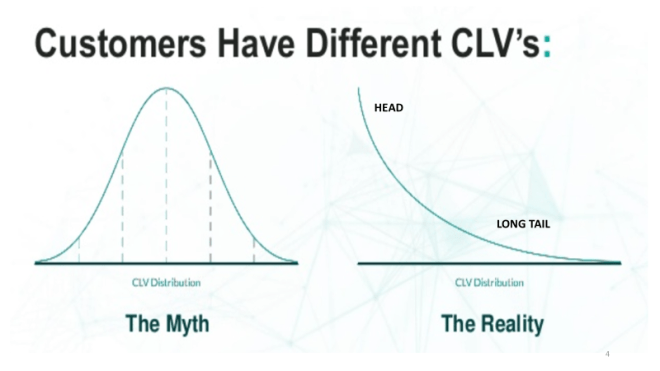
Customer Lifetime Value (CLV) helps separate customers into the three buckets. As should be obvious by now, CLV distribution is not a bell curve (normal distribution) but one with an exponential decay, as this image from a Zodiac and Infotrust Webinar shows:

Best Customers constitute the “head”, with the bottom 50% constituting the “long tail.” Yet, most marketers are obsessed with the Median Marketing approach. For one, it is easy to do. Offers for all, campaigns for all, same website for all, same app experience for all, churn reduction for all, and so on. It is communism applied to marketing!

What smart marketers do is to think capitalism. There is inequality – and that’s a good thing. In an economy, what matters is not the quantum of inequality but the income of the poorest. Being poor in a rich country can still deliver a decent lifestyle. In marketing, what matters is the spends and profits from the Best Customers. Their CLV is what should be maximised. This is what Velvet Rope Marketing does. It is capitalism applied to marketing.

Tomorrow: Velvet Rope Marketing (Part 5)

Velvet Rope Marketing (Part 3)

The key to identifying Best Customers for Velvet Rope Marketing (VRM) is in identifying their Customer Lifetime Value (CLV). As Peter Fader explains in his book, “Customer Centricity”:

Customer Lifetime Value (CLV) is a forward-looking, predictive measurement that is calculated by modelling and projecting the following:

  • How long the customer relationship lasted (for churned customers) or is likely to last (for active and future customers)
  • Number of transactions
  • Value of the transactions
  • Other non-financial activities the customer may engage in. Eg. visits to website, willingness to try other products, posting ratings and reviews about the company’s products, and/or referring other prospective customers

There are many other benefits of using CLV:

  • Higher revenue, greater satisfaction, lower churn
  • Differentiation in customer service
  • Better targeted marketing spend
  • Move from cost per acquisition to value per acquisition
  • Quality retention – 5% increase in customer retention can increase a company’s profitability by 75%
  • More accurate sales forecasting
  • Better information for product design and planning
  • Better project prioritisation
  • Refunds and other such decisions

Here are three things you can do to get started:

  • Calculate CLV based on transaction data for each of your customers
  • Segment your customers into Best (top 20%), Rest (next 30%), Other (remaining 50%)
  • Create your own Velvet Rope Marketing program to provide a differentiated experience to your Best Customers – using a combination of martech and adtech solutions

In a nutshell: VRM is about making choices. Companies should not try to treat every customer the same. They should create an amazing experience for their Best Customers who are likely to contribute to a majority of the revenue and a disproportionately large share of profits. In times when hard choices will be required of marketers and enterprises, VRM can be the answer to retaining the right customers and growing profits.

Tomorrow: Velvet Rope Marketing (Part 4)

Velvet Rope Marketing (Part 2)

Velvet Rope Marketing (VRM) is much more than a loyalty program. In a loyalty program, anyone can sign-up and collect points. In a VRM program, it is the brand that decides which customers are eligible for the differentiated experience. Many companies have a loyalty program, but very few do VRM. By missing out on deepening relationships with their best customers, they are losing out on opportunities to increase their profits – because Best Customers can be many times more valuable than the median customers.

So, what can companies do for their Best Customers? Here are a few examples:

  • eCommerce: Give 3 free exchange opportunities to best customers; Design a special page based on customer preferences – combination of things they like, new season/ launches, offers
  • OTT: Ask best customers for preferences to recommend for the following week; Give early access or preview (music, tv shows, movies etc.)
  • Retailer: With data on items that the best customer searched for but weren’t available at the time, retail stores can give them the first chance to buy those or similar items when in stock; give offers for items similar to customer’s previous purchases
  • Multiplex: Predict what best customers are likely to order and place in the cart/ offer an easy buy option
  • Manufacturer: Give privileged opportunity to buy a new collection from company/brand or even design new products

Another way to think is along the three dimensions of Exclusivity, Envy and Access – as outlined in the book “The Velvet Rope Economy”.  Here are some more examples of differentiated service examples:

Exclusivity

  • Get premium samples free – from wishlist and new launches
  • Get a special page designed based on preferences – likes, new season, offers
  • Get notifications on topics of interest
  • Participate in product co-development
  • Cancel tickets or orders without loss

Ease

  • Pre-book a slot based on visit patterns, etc; get an assigned concierge
  • Get free exchange opportunities
  • Pick their own seats in advance (flight, theatre etc.)
  • Order service/product before arriving on-premise
  • Preferential treatment from customer service; first-in-line always

Access

  • Get invited to media events celebrating the brand’s loyal customers, to get first-look at products
  • First opportunity to book an order for limited edition apparel
  • Offers for orders similar to previous purchases
  • An earlier opportunity to buy tickets for upcoming events

Which brings us to the key question: how does one identify Best Customers?

Tomorrow: Velvet Rope Marketing (Part 3)

Velvet Rope Marketing (Part 1)

Over the next year or two, companies are going to see profits under pressure, marketing budgets getting minimised and capital being constrained. At the same time, business needs to continue. What can enterprises do to strengthen their market positions given these limitations? The answer: Velvet Rope Marketing.

I recently read Sunil Gupta’s book, “Driving Digital Strategy.” There was one idea that stood out (among the many excellent ones in the book): the 200-20 Rule. Here is what he writes: “According to the familiar 80-20 rule, 20 percent of the customers provide 80 percent of the revenue. However, research shows that if we focus on profitability instead of revenues, the rule would be 200-20, where 20 percent of the customers provide almost 200 percent of the profit!  How is that possible? Because the remaining 80 percent of customers actually destroy profitability.”

I have also been thinking about another related idea outlined by Peter Fader in his two books on customer centricity – that of focusing on best customers to maximise profits. A few quotes from his books:

  • “The Customer” does not exist because every customer is different.
  • The customer is not always right. The right customers are always right.
  • In the world of customer-centricity, there are good customers…And then there is everybody else.

Building on the concepts outlined and through conversations with marketers, I came up with the idea of “Velvet Rope Marketing” (VRM) – focus on creating a differentiated experience for the Best Customers as identified by customer lifetime value (CLV) to maximise profits. Best Customers sign-up early, stay longer, spend more, spread wider and are serviced easier.

For these customers, companies need to roll out the “velvet rope” experience to treat them like royalty. We have seen the velvet rope (with the red carpet) at airline first class and business class check-in counters, and at the exclusive entrances at Disneyland. It creates exclusivity, envy and a feeling of being special. VRM can help generate additional revenues, higher profits, loyalty and word-of-mouth.

Tomorrow: Velvet Rope Marketing (Part 2)

Proficorns vs Unicorns (Part 6)

I realised that I had gone astray in the chase for valuation. I had become an investor in my business trying to become a unicorn (even though that word did not exist then). I had thrown all caution out of the window. We had hired indiscriminately, and had lost control of the expenses. I chased a rainbow. I had forgotten my own lessons in building IndiaWorld a decade ago. The sermons I gave on profitability – well, I had started doing exactly the opposite.

Bhavana opened my eyes. And I learnt a lesson I have not forgotten to this day. The purpose of a business is to create value for its shareholders, employees and customers. And it cannot do so if it is not profitable. It is hard to do it with an insatiable appetite of funds with all kinds of bad habits creeping in.

As it turns out, that story did have a happy ending. In less than a year, we made the business profitable. And Netcore has never lost money after that in the past 12 years.

We have gone through multiple shocks over the years – and every one of them has made us stronger. We are what Nassim Taleb would call antifragile. And that is probably true of all proficorns. Each one has a story to tell. But the world is fascinated by the stories of funds raised by young startups, not the profitability of older companies.

It is not that the world does not need capital to fund companies. Some businesses do require capital to begin with. The problem is when raising capital becomes the primary business model rather than embarking on a path to creating a profitable and sustainable business. That’s the contrast I wish to draw. There is an alternate model to build a business, and it is in times of crises that the differences stand out.

For entrepreneurs, the choice is for them to make. For me, building a business that is antifragile, that has the innate financial heft and freedom to convert a crisis into an opportunity, and that can hire and grow is the right way to do business. The Proficorn Way is my choice. What’s yours?

Proficorns vs Unicorns (Part 5)

Unicorns are fragile, while proficorns are antifragile. To understand this very important difference, let us first understand what Taleb means when he talks about something being antifragile. Here is an excerpt from his book:

Some things benefit from shocks; they thrive and grow when exposed to volatility, randomness, disorder, and stressors and love adventure, risk, and uncertainty. Yet, in spite of the ubiquity of the phenomenon, there is no word for the exact opposite of fragile. Let us call it antifragile. Antifragility is beyond resilience or robustness. The resilient resists shocks and stays the same; the antifragile gets better. This property is behind everything that has changed with time: evolution, culture, ideas, revolutions, political systems, technological innovation, cultural and economic success, corporate survival, good recipes (say, chicken soup or steak tartare with a drop of cognac), the rise of cities, cultures, legal systems, equatorial forests, bacterial resistance … even our own existence as a species on this planet. And antifragility determines the boundary between what is living and organic (or complex), say, the human body, and what is inert, say, a physical object like the stapler on your desk.

The antifragile loves randomness and uncertainty, which also means— crucially—a love of errors, a certain class of errors. Antifragility has a singular property of allowing us to deal with the unknown, to do things without understanding them— and do them well. Let me be more aggressive: we are largely better at doing than we are at thinking, thanks to antifragility. I’d rather be dumb and antifragile than extremely smart and fragile, any time.

Crises make unicorns weaker and proficorns stronger. Unicorns are fragile, while proficorns are antifragile. It is the stresses that makes the proficorns who they are.

Netcore faced a big crisis around 2007-8. For a while, I too was taken up by the chase for valuations. Before I realised it, we were losing Rs 1 crore a month, chasing a mythical valuation of an SMS-led, capital-fed consumer business. It was at that time that my wife, Bhavana, returned to Netcore after a 3-year break following the birth of our son. She was aghast at what she saw and gave me an ultimatum: be profitable in a year, or shut the business down. Her training in accounts —  she is a CA — did not allow her to see money just being burnt at the altar of something as ephemeral as valuation! That was what opened my eyes. It was a lesson in financial management that I did not forget.

Tomorrow: Proficorns vs Unicorns (Part 6)

Proficorns vs Unicorns (Part 4)

For me in Netcore, this is a great opportunity to look at expansion – to complement organic growth with acquisitions. The money saved for rainy days now comes in handy. It is like the tale of the ant and grasshopper. All the past hard work can now bear fruit as new worlds open up and assets that were previously unavailable could perhaps be bought at attractive prices.

Opportunities come not just in the form of acquisitions, but also in the form of hiring talent and acquiring new customers. By viewing business as an infinite game, proficorns can use troubled times to lay a very strong foundation for the future.

Crises are an opportunity to put one’s head down and reimagine the world that will emerge on the other side. One cannot do that if one doesn’t have control over one’s own destiny. For the proficorn founders, there are no investors with blanket diktats breathing down their necks. They can sit back with a cool mind and not worry about the next quarter or two, but think of the future beyond. That is how breakthrough businesses are built. I have always believed that when I am building a business, even as I have to worry about Monday morning, we are actually “competing for the future” – one that we have to create.

In good times, everyone can thrive. Those who splurge more can perhaps move faster. But this growth has its costs. There are economic cycles. And when a slowdown or downturn comes, the fall can be fast. It is the bad times that separate the truly resilient ones from the others. The skin in the game that founders of proficorns have enables them to see around corners much better, and this creates a better built-to-last business.

So far, we have seen two big differences between unicorns and proficorns during tough times: the fire vs hire mindset, and a crisis vs opportunity worldview. There is a third big difference which gets magnified.

Tomorrow: Proficorns vs Unicorns (Part 5)

Proficorns vs Unicorns (Part 3)

The second big difference during challenging times is the mindset of the founders and entrepreneurs – unicorns see a crisis, proficorns see an opportunity. And central to this is the idea of “skin in the game.”

In unicorns, founders are left with a small stake after multiple rounds of funding. While the value of their holding increases (on paper), the investors become the majority owners of the company. It is not uncommon to see founders with just a 10-20% share in the company they founded. As a result, the investors call the shots. The founders become glorified managers in the very company they created. They are simply working to increase the wealth of the investors – for whom the company is just one among many investments. In other words, the founders have very little skin in the game.

As a result, when investors see a crisis because of capital and liquidity issues, the founders are forced to see the world the way the investors see it. It is time for “crisis management.” Customers are not the priority; protection of the invested capital is. And for that, if employees have to be fired, so be it. If customer service has to be reduced, so be it. Survival is the only goal that matters. This crisis mentality permeates all decision-making. It is like there is no tomorrow or the day after – just today that needs to be gotten through. Very few investors have the luxury of giving the founders the operational freedom to think long-term and make their own decisions.

In proficorns, a different mindset operates. The founders have no investors to report to. They have complete skin in the game. The company is their life’s work. If the company dies, they lose a part of themselves. Proficorns become what they become by going against the flow. And this is where founders of proficorns see a crisis as an opportunity. When others are panicking, it is time to sit with a cool head and think ahead – look beyond the immediate to the new world that will be created once the tempest fades away.

Tomorrow: Proficorns vs Unicorns (Part 4)