How Velvet Rope Marketing can transform Customer Loyalty (Part 8)

Rethinking Loyalty

I recently signed up on an online clothes shopping platform. They had a loyalty program. So I registered for that. I got the base level of points. Later that day, I asked my wife (a frequent shopper on the same online platform) if she had joined the loyalty program. She replied in the negative. So, I signed her up. And guess what – both of us had the same base level of points! Her entire purchase history of many years had been discarded when it came to loyalty and she was on a level playing field with me! Of course, in the future, she will earn more points because of her higher spending – but for now, it was like both of us were starting afresh.

This reminded me of the movie “Fifty First Dates” – where the heroine has short-term memory loss. She wakes up each day with no idea of who she is or who her family members are. So, she has to be reminded each day of her life stage. A video each day reminds her of her past so she can enjoy the waking hours better.

Many brands suffer from the “Fifty First Dates” syndrome. They ignore the past – and some even ignore the present and future. They think that a half-baked loyalty program is all that they need to ensure customer loyalty. What they are not seeing are the significant benefits that a well-designed program with a forward-looking CLV can do for customer retention.

Let’s add one more dimension into this mix. There are two multiplexes near my house, and I tend to split movie watching between the two. None of them remember me from my previous visits so for me there is no real experience differentiation other than the show time and availability of good seats. If they were to look at my transaction history, they would think I am a reasonably loyal customer – watching a movie every few weeks. But what they will not see is that I am giving half my business to their competitor!

This is why I emphasised the need to look at the spending in a category. That is the revenue and profit pool that needs to be maximised, and most brands have no idea about the money they are leaving on the table. And that’s the reason existing approaches to customer loyalty are flawed and need a rethink. Velvet Rope Marketing is the big idea that can transform not just loyalty programs but customer loyalty itself. VRM is the key to opening the door to creating a “profi-poly” (profits monopoly).

Tomorrow: Part 9
How Velvet Rope Marketing can transform Customer Loyalty (Part 7)

Loyalty Metrics

Before we get to the “how” of rethinking customer loyalty, let us take a look at some of the metrics that have emerged over the years to measure customer loyalty:

Capillary offers a good summary of the many loyalty metrics:

  1. Net Promoter Score: Gauge your customer loyalty with a Net Promoter Score, which asks one essential question: How likely are you to refer our service? Not only does this let you know how satisfied a customer is, but it also tests how likely they are to purchase again–without annoying them with a long list of questions.

  2. Repurchase Ratio: The repurchase ratio gives you the number of customers who come back to your business repeatedly, divided by one-time purchasers.

  3. Upsell Ratio: [This is] the ratio of customers who’ve bought more than one type of product to the customers who’ve bought only one.

  4. Customer Lifetime Value: CLV is an understanding of the total revenue attributed by the entire relationship (including future purchases) with a customer.

  5. Customer Loyalty Index: CLI takes into consideration multiple factors like NPS, upselling, and repurchasing. It accomplishes this through a questionnaire addressing these three essential points: “How likely are you to recommend us to your friends and family? How likely are you to buy from us again in the future? How likely are you to try our other products?”

  6. Customer Engagement Score: [This] assigns every customer a score based on their individual activity and usage of your services.

All of these are good metrics. As I started thinking about customer loyalty, I thought about it differently. What would I as a business or brand want? A monopoly! Wouldn’t I love it if all my customers bought all their needs only from me? Each customer has a different threshold of spending. So, if I could figure out all that they were spending in that category and ensure they only buy from me, I could then ensure a competition-free business – which is the ultimate objective of a business and the path to supernormal profits. Of course, this never happens in reality. Customers have different needs and no business can cater to every one of their needs. Yet, some businesses come close. Google in Search and Microsoft in operating system software are two examples. Google’s Search gets our attention which is then monetised, while Microsoft gets our dollars for its near ubiquitous Windows and Office combo.

For a business, the key then is to identify the Best Customers in its category, and ensure it can get a maximum of them. Once they are acquired, the key would be to figure out what is their spending threshold in the category, and then aim to maximise wallet share of that spend. This approach can cut off the oxygen of revenue and profits from competitors. This needs fostering extreme customer loyalty. That is why I think we need to define customer loyalty differently: receiving more than 50% of the spending (attention or money) by a customer in the category.

To maxmimse profits, businesses need a new approach to thinking about loyalty and loyalty programs. This is where Velvet Rope Marketing comes in.

Tomorrow: Part 8

How Velvet Rope Marketing can transform Customer Loyalty (Part 6)

Loyalty Programs

This is a good time to take a small detour into the world of customer loyalty programs and the data that goes into them. Our guide is Ajay Row. In a series of posts on LinkedIn a couple years ago, Ajay Row dug deep into customer loyalty programs.

To my mind, there are two purposes to a loyalty program:

  1. Reliably and consistently deliver profitable revenues in good times and bad. Revenues include both core revenues (company’s main business via retention, cross-sell, up-sell and new business via Member-Get-Member type programs and sharing positive reviews) and ancillary (typically membership fees, profits at redemption and money made via external partners who value the member base).
  2. To consistently deliver incremental actionable (and actioned!) insight. All the way from the overall base, through effective segments down to what could be millions of “audiences of one”.

The loyalty program is the price you pay to get these two. How does it work?

Loyalty programs deliver four levers:

  1. Data: at an individual member level includes profile, transaction, interaction, stated and inferred/observed preferences and finally derived data (i.e. data you build from data goes all the way from H / M / L value members through Cohorts to price sensitivity and basket type). This data, which is of course “internal” to the loyalty program, can be overlaid with data external to the program and even external to the company to build more value. Example, building geographical or seasonal models by individual members.
  2. Communication: the program has the opportunity, even the responsibility, after all the member has put up a hand and said they want to be a friend, to communicate respectfully and effectively. Communication keeps members engaged and typically covers one of three broad areas: brand/relationship building with the individual member, incremental reasons for a profitable behavior (e.g. point-based promotions that aren’t available to non-members) and program-related information (new status, number of points). Sometimes, a single point statement is enough to achieve all three ends.
  3. Rewards / Currency: the program, if well designed can deliver a currency other than money, one that can be even more valuable than cash depending on how effectively the redemption works, and the company controls the value! Using what we call the Value Per Point and Cost Per Point difference is one of the key levers by which loyalty programs make money. Point liability is fascinating game to play, but that will have to wait for another article.
  4. Recognition: the program can make your most valuable members feel exceptional by recognizing them as being special to you. And the program if designed with a little imagination can do this at an individual member level. Based on their value but also based on what is valuable to them.

Armed with these four levers, the loyalty program can deliver both reliably profitable revenues and incremental insights.

One of the key facets of any loyalty program is data. Here is how Ajay Row explains the different types of data:

  1. Profile data: Member-given (e.g name, address, preferences, interests, etc.) — members puts up their hands and offer friendship, investing time to teach the organization about themselves. It the organization’s responsibility to think this one through carefully, what will we ask? How will we use it? Is it overly intrusive given our brand values?

  2. Transaction data: System-generated (e.g. typically spends and related categorization data etc.)

  3. Interaction data: System-collected (e.g. visits, social media related, eDM responses etc.)

  4. Point related data: System-calculated(e.g. points earned, redeemed, balance, expired, bonus etc.)

  5. Financial data: System-generated (e.g. transaction and customer profitability, point liability etc.)

  6. Environmental data: Variously-collected, as far as possible, systematically (e.g. season, TOD/DOW, advertising running at the time)

  7. Derived data: System-calculated (i.e. data derived, usually totaled, from some permutation or combination of the data sources above e.g. customer value growth, customer life-time value, cohort analysis, clusters and segments, correlations and causation etc.)

As Ajay Row summarises it: The objective of any loyalty program and hence analytics project is to: [Maximize the Sum of Customer Life Time Values across the Member Base].

As we will see going forward, calculating customer lifetime value (CLV) right to then correctly identify the Best Customers is the key to winning in customer loyalty.

Tomorrow: Part 7

How Velvet Rope Marketing can transform Customer Loyalty (Part 5)

Loyal Customers

That customer loyalty should be one of the central pillars for any business or brand is obvious. Here comes more reinforcement from a blog post on Nicereply:

While it’s obvious that customers who come back to spend more money is good for business, there’s other, more subtle, benefits to loyal customers.

It’s like the old leaky bucket metaphor. Imagine a business as a bucket. Customers flow in and fill the bucket up. A successful business has a full bucket of customers (and profits).

However, imagine the bucket has a hole in it. Customers who flowed into the bucket start to leak out the hole. Losing customers is called churn, and it has a large effect on business growth. Even if you can somehow start filling the bucket faster, you’re still losing valuable customers. Patching up the hole (or improving customer retention) means keeping more customers in the business bucket. A 5% increase in customer retention increases business profits by 25%-95%.

If it cost the same amount to replenish the customers lost through the leak, then churn wouldn’t be such a big deal. Unfortunately, it’s much more expensive to get new customers into the bucket than continue to sell to existing customers. It’s estimated that new customers cost five times more to convert than existing customers.

Finally, loyal customers also make recommendations to family and friends.

There are many good reasons for making customer loyalty core to the brand. Yet, for most brands, the focus tends to be more on new customer acquisition rather than retention, which in turn means ensuring loyalty. New customer acquisition is where the bulk of marketing budgets get spent. Google and Facebook have made it very easy to point-and-click and pay for running acquisition campaigns. Acquisition-related metrics are the ones that get discussed in top management meetings. Everyone else is running ads, and so should the brand. Someone else’s customer needs to become the brand’s new acquisition, so attractive offers are dangled. And in all this, the quiet, repeat purchasing existing customer is all but ignored. Until it is too late.

This is what needs to be addressed by a rethink at two levels: making retention the new acquisition, and focusing retention efforts on the Best Customers. A loyalty program is seen as a great way to retain and reward the best customers.

Tomorrow: Part 6

How Velvet Rope Marketing can transform Customer Loyalty (Part 4)

Loyalty Today

Let us begin by looking at the current state of customer loyalty.

SendPulse offers a good starting definition of customer loyalty: “Customer loyalty is a measure of a customer’s likeliness to do repeat business with a company or brand. It is the result of customer satisfaction, positive customer experiences, and the overall value of the goods or services a customer receives from a business.”

Here’s more from SendPulse:

When a customer is loyal to a specific brand, they are not easily influenced by availability or pricing. They are willing to pay more as long as they get the same quality product or service they are familiar with and love. Other characteristics of a loyal customer include the following:

  • they are not actively searching for different suppliers

  • they are more willing to refer a brand to their family and friends

  • they are not open to pitches from competing companies

  • they are open to other goods or services provided by a particular business

  • they are more understanding when issues occur and trust a business to fix them

  • they offer feedback on how a brand can improve its products or services

  • as long as there is a need, they will keep purchasing from a business

Hubspot adds:

Customer loyalty is something all companies should aspire to simply by virtue of their existence: The point of starting a for-profit company is to attract and keep happy customers who buy your products to drive revenue.

Customers convert and spend more time and money with the brands they’re loyal to. These customers also tell their friends and colleagues about those brands, which drives referral traffic and word-of-mouth marketing.

Customer loyalty also fosters a strong sense of trust between your brand and customers — when customers choose to frequently return to your company, the value they’re getting out of the relationship outweighs the potential benefits they’d get from one of your competitors.

Since we know that it costs more to acquire a new customer than to retain an existing customer, the prospect of mobilizing and activating your loyal customers to recruit new ones — simply by evangelizing a brand — should excite marketers, salespeople, and customer success managers.

So, customer loyalty = customer delight = more spending = less churn and more referrals = higher profits = happy customers and happy brands! And yet, look at the brands we do business with and whom we are loyal to – are we truly getting a differentiated experience from those brands? It is a question we will return to later in the series.

Tomorrow: Part 5

How Velvet Rope Marketing can transform Customer Loyalty (Part 3)

Customer Pyramids

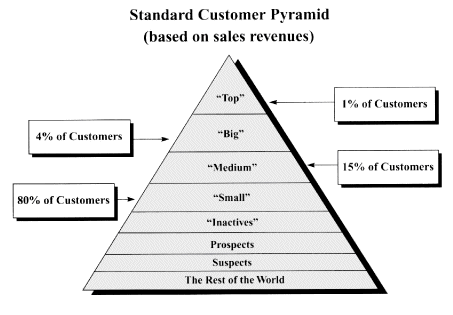
The ideas of customer loyalty are not new. A friend recommended a book published in 2000 – “The Customer Marketing Method” by Jay Curry and Adam Curry. The book discusses the customer pyramid as shown below:

The simple 3-step customer marketing strategy as outlined by the authors is:

  1. Get new customers into your pyramid.
  2. Move customers higher in your pyramid.
  3. Keep customers from leaving the pyramid.

In other words, acquisition, retention and development of customers.

The authors also outline 10 lessons they have learnt from customer pyramids:

  1. The top 20% of the customers deliver 80% of revenues
  2. The top 20% of the customers deliver more than 100% of profits.
  3. Existing customers deliver up to 90% of revenues.
  4. The bulk of marketing budgets is often spent on noncustomers.
  5. Between 5% and 30% of all customers have the potential for upgrading in the customer pyramid.
  6. Customer satisfaction is critical for migration up the pyramid.
  7. Reasonably satisfied customers often defect to the competition.
  8. Marketing and sales are responsible for influencing customer behavior.
  9. Other departments and people also influence customer behavior—for better or worse.
  10. A 2% upward migration in the customer pyramid can mean 10% more revenues and 50% more profit!

Many of the lessons are timeless. A small fraction of customers account for disproportionate share of revenues and profits – think of these as the Best Customers. To paraphrase George Orwell’s famous quote in Animal Farm, “All customers are equal, but some customers are more equal than others.” Marketing efforts must focus on these customers, even as efforts are made to move some of the others (Rest) up to pyramid.

One can call it customer centricity or customer loyalty or any other term. The key to business success remains in identifying the category’s best customers, attracting and retaining them forever, and then getting them to recommend their family and friends. Data and technology make this easier and more competitive. That is where innovative thinking around customer loyalty as manifested in the ideas of Velvet Rope Marketing can make all the difference.

Tomorrow: Part 4

How Velvet Rope Marketing can transform Customer Loyalty (Part 2)

Loyalty vs VRM

The aspiration of every business is customer loyalty. In simple terms, customer loyalty translates into repeat business. The cost of acquiring a new customer is many times that of retaining an existing customer, hence customer loyalty also means higher profits for a business. If customer churn, a business cannot create a growth story and a profits flywheel. Thus, customer loyalty is central for business success.

I started thinking more deeply about customer loyalty during recent conversations with CMOs as part of the meetings I have been doing on Velvet Rope Marketing (VRM). VRM is about a focus on the Best Customers – the top 20% or so customers who account for a disproportionately high share of revenue and profits. For many businesses, Best Customers can deliver 60% or more revenues and greater than 100% of the profits – since many of the Rest Customers can be loss-making when acquisition and servicing costs are factored in. VRM’s key thesis is that Best Customers need a differentiated experience because of their importance to the business.

Loyalty programmes are one way to reward customers. The more a customer spends, the more points they earn. These points can in turn be redeemed for rewards. To make it more lucrative for loyal customers, tiers can be created where higher tiers generate more points. Airlines do this very well. There is hardly a frequent flyer to be found who is not part of the airline’s loyalty program.

As I see it, there are some very big differences between the standard loyalty programs offered by brands and VRM. Typically, anyone can opt-in to a loyalty program and start earning points. The brand does not control who joins. There is also very little experience differentiation – the points are linked to spending, and that’s about it. In VRM, it is the brand which decides who gets to be part of the differentiated experience. Think of VRM as ‘By Invitation Only’, an exclusive club whose entry is decided by an algorithm which calculates Customer Lifetime Value (CLV), a forward-looking and predictive metric based on the expected future transactions and their value. CLV, as used for VRM, can be a better measure of segmenting customers and determining Best Customers.

Any brand can offer a loyalty program with rewards. Customer Experience differentiation via VRM for Best Customers can become the moat a brand builds to ensure greater customer loyalty, higher spending and a ‘profits monopoly.’ This can give us a new definition for customer loyalty – receiving more than 50% of the spending by a customer in the category. We will build on these ideas in this series.

Tomorrow: Part 3

How Velvet Rope Marketing can transform Customer Loyalty (Part 1)

Customer Centricity Quiz

“We are a customer-centric company.” We hear this all the time. Yet, many companies lose out to competitors. Their customers surely did not think they were customer-centric! How can you ensure your company is not of those?

Here is a Customer Centricity quiz to help you understand how well your business builds the right relationships with your customers. Give yourself 1 point for every Yes that you answer.

  1. Do you collect data at every customer touchpoint (offline, online, call centre, etc.)?
  2. Are you able to get a unified view of every customer?
  3. Do you know the identity, revenue and profitability contribution of your best customers?
  4. Can you predict the lifetime value of all your customers?
  5. Is the lifetime value calculation based on recency AND frequency of customer transactions?
  6. Is there a differentiated experience that you provide to your best customers?
  7. Do you use info about your best customers to better target new customer acquisition and onboarding?
  8. Do you have a referral marketing program targeted at your best customers?
  9. If a best customer walked into a store or came to your website/app or churned (became inactive), would you know?
  10. Is measuring and increasing customer loyalty one of the top 3 CEO priorities?

Scoring:

  • 8-10: Congratulations! You (and your business) are a Customer Centricity Champion. The next phase is to look at actual implementation. Here are 5 more questions for you – same rules apply (count the number of Yes answers).
    • Do you practice the 4Rs philosophy – right message to the right person at the right time via the right channel?
    • Are you able to decide on the next best action for every customer to nudge them along in their journey?
    • Do you personalise the experience of your customers based on the data you collect?
    • Do your emails get delivered to the primary inbox of your customers? Do your push notifications get delivered to a majority (more than 75%) of your customers? (half point for each)
    • Do you have a culture of testing every communication for impact?
  • 6-7: Customer Centricity Learner. The DNA is there, but there is room for improvement. Look at each of the questions where you answered a No and prepare a plan to make that into a Yes. Your next action should be to convert one No into a Yes every quarter going forward – so pick one of the themes and begin.
  • Less than 6: Customer Centricity Newbie. You are leaving a lot of money on the table for competitors. There could be many reasons, but perhaps the most important is that customer centricity needs to immediately become a CEO priority and driven across all departments.

As you would have guessed, the customer centricity quiz is centred around customer loyalty and has embedded in it many ideas for actions that can help grow revenue and profits for your business. Creating lifetime customer loyalty is the most important goal of your business when it starts – and yet, many lose their way with the passage of time opening the way for attack by data-driven, customer relationship-centric, loyalty-obsessed competitors. Bringing the focus back to customer-centricity, attracting the best customers in the category and fostering lifetime loyalty is the key for growing revenues and profits.

Tomorrow: Part 2

Announcing: MartechBrain

I have started a new weekly show, MartechBrain. It is a Netcore initiative to probe marketers and digital leaders on the one idea that they are most passionate about.

Here are the first three episodes on YouTube:

MartechBrain will be available soon via Spotify, Google Podcasts and Apple Podcasts, and also via Netcore’s website.

My Proficorn Way (Part 35)

Disagree and Commit

It was Girish who once said in an internal meeting, “I disagree and commit.” I was taken aback by the choice of words. What exactly did this mean? Weren’t we all supposed to agree on the way forward? Wasn’t that what meetings were for?

It was then that Girish explained the phrase. It came from his time at Intel. One did not have to agree with the decisions made in the meeting. One could voice the dissent. But at the end, everyone present would commit to the decisions made. “Disagree and Commit.” After that, there would be no public disagreement or grumbling – everyone would work together to make a success of what had been decided.

I found the choice of words fascinating. “Disagree and Commit.” In India, many times we keep our feelings to ourselves even if we don’t agree. We then tend to keep an inner grudge that the outcome did not go our way. Because of this hidden dissatisfaction, we could even end up undermining the success of the initiative. “Disagree and Commit” does away with this. Voice with all candour, but once the group has decided, there is no grumbling and murmuring. Everyone is united as one to implement what the group has decided.

Inc.com writes about what Jeff Bezos wrote in one his letters to shareholder about the phrase:

This phrase will save a lot of time. If you have conviction on a particular direction even though there’s no consensus, it’s helpful to say, “Look, I know we disagree on this but will you gamble with me on it? Disagree and commit?” By the time you’re at this point, no one can know the answer for sure, and you’ll probably get a quick yes.

I disagree and commit all the time. We recently greenlit a particular Amazon Studios original. I told the team my view: debatable whether it would be interesting enough, complicated to produce, the business terms aren’t that good, and we have lots of other opportunities. They had a completely different opinion and wanted to go ahead. I wrote back right away with “I disagree and commit and hope it becomes the most watched thing we’ve ever made.” Consider how much slower this decision cycle would have been if the team had actually had to convince me rather than simply get my commitment.

Inc adds:

How many of us have seen great ideas killed by attrition?

A lot of business leaders claim to support bias for action, but they don’t practice what they preach. Either they refuse to green-light any project that strays outside their comfort zone, or they indirectly sabotage the project by not providing the resources or support it would need to succeed.

Yes, effective leaders know when to trust their gut. But they also know when to trust their teams’ gut. They’re willing to take calculated risks. In doing so, they help their people gain confidence, and give them room to experiment and grow.

…It may be time to disagree and commit.

Because when you go all in with people you trust, good things tend to happen.

“Disagree and Commit” is a phrase I too have used many times. I do not ask for the others to convince me. I do not impose my view on the group. I make my view public and yet promise to work as part of the united team for the outcome.

Make this phrase part of your entrepreneurial vocabulary. You will be all the better for it.

Will be continued soon.