How Velvet Rope Marketing can transform Customer Loyalty (Part 3)

Customer Pyramids

The ideas of customer loyalty are not new. A friend recommended a book published in 2000 – “The Customer Marketing Method” by Jay Curry and Adam Curry. The book discusses the customer pyramid as shown below:
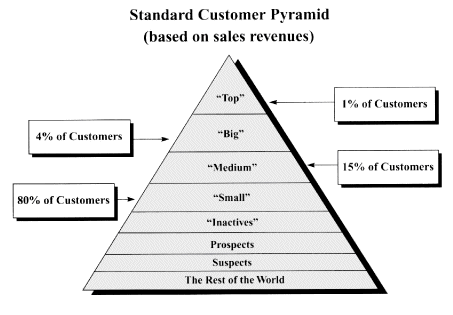
The simple 3-step customer marketing strategy as outlined by the authors is:

  1. Get new customers into your pyramid.
  2. Move customers higher in your pyramid.
  3. Keep customers from leaving the pyramid.

In other words, acquisition, retention and development of customers.

The authors also outline 10 lessons they have learnt from customer pyramids:

  1. The top 20% of the customers deliver 80% of revenues
  2. The top 20% of the customers deliver more than 100% of profits.
  3. Existing customers deliver up to 90% of revenues.
  4. The bulk of marketing budgets is often spent on noncustomers.
  5. Between 5% and 30% of all customers have the potential for upgrading in the customer pyramid.
  6. Customer satisfaction is critical for migration up the pyramid.
  7. Reasonably satisfied customers often defect to the competition.
  8. Marketing and sales are responsible for influencing customer behavior.
  9. Other departments and people also influence customer behavior—for better or worse.
  10. A 2% upward migration in the customer pyramid can mean 10% more revenues and 50% more profit!

Many of the lessons are timeless. A small fraction of customers account for disproportionate share of revenues and profits – think of these as the Best Customers. To paraphrase George Orwell’s famous quote in Animal Farm, “All customers are equal, but some customers are more equal than others.” Marketing efforts must focus on these customers, even as efforts are made to move some of the others (Rest) up to pyramid.

One can call it customer centricity or customer loyalty or any other term. The key to business success remains in identifying the category’s best customers, attracting and retaining them forever, and then getting them to recommend their family and friends. Data and technology make this easier and more competitive. That is where innovative thinking around customer loyalty as manifested in the ideas of Velvet Rope Marketing can make all the difference.

Tomorrow: Part 4

How Velvet Rope Marketing can transform Customer Loyalty (Part 2)

Loyalty vs VRM

The aspiration of every business is customer loyalty. In simple terms, customer loyalty translates into repeat business. The cost of acquiring a new customer is many times that of retaining an existing customer, hence customer loyalty also means higher profits for a business. If customer churn, a business cannot create a growth story and a profits flywheel. Thus, customer loyalty is central for business success.

I started thinking more deeply about customer loyalty during recent conversations with CMOs as part of the meetings I have been doing on Velvet Rope Marketing (VRM). VRM is about a focus on the Best Customers – the top 20% or so customers who account for a disproportionately high share of revenue and profits. For many businesses, Best Customers can deliver 60% or more revenues and greater than 100% of the profits – since many of the Rest Customers can be loss-making when acquisition and servicing costs are factored in. VRM’s key thesis is that Best Customers need a differentiated experience because of their importance to the business.

Loyalty programmes are one way to reward customers. The more a customer spends, the more points they earn. These points can in turn be redeemed for rewards. To make it more lucrative for loyal customers, tiers can be created where higher tiers generate more points. Airlines do this very well. There is hardly a frequent flyer to be found who is not part of the airline’s loyalty program.

As I see it, there are some very big differences between the standard loyalty programs offered by brands and VRM. Typically, anyone can opt-in to a loyalty program and start earning points. The brand does not control who joins. There is also very little experience differentiation – the points are linked to spending, and that’s about it. In VRM, it is the brand which decides who gets to be part of the differentiated experience. Think of VRM as ‘By Invitation Only’, an exclusive club whose entry is decided by an algorithm which calculates Customer Lifetime Value (CLV), a forward-looking and predictive metric based on the expected future transactions and their value. CLV, as used for VRM, can be a better measure of segmenting customers and determining Best Customers.

Any brand can offer a loyalty program with rewards. Customer Experience differentiation via VRM for Best Customers can become the moat a brand builds to ensure greater customer loyalty, higher spending and a ‘profits monopoly.’ This can give us a new definition for customer loyalty – receiving more than 50% of the spending by a customer in the category. We will build on these ideas in this series.

Tomorrow: Part 3

How Velvet Rope Marketing can transform Customer Loyalty (Part 1)

Customer Centricity Quiz

“We are a customer-centric company.” We hear this all the time. Yet, many companies lose out to competitors. Their customers surely did not think they were customer-centric! How can you ensure your company is not of those?

Here is a Customer Centricity quiz to help you understand how well your business builds the right relationships with your customers. Give yourself 1 point for every Yes that you answer.

  1. Do you collect data at every customer touchpoint (offline, online, call centre, etc.)?
  2. Are you able to get a unified view of every customer?
  3. Do you know the identity, revenue and profitability contribution of your best customers?
  4. Can you predict the lifetime value of all your customers?
  5. Is the lifetime value calculation based on recency AND frequency of customer transactions?
  6. Is there a differentiated experience that you provide to your best customers?
  7. Do you use info about your best customers to better target new customer acquisition and onboarding?
  8. Do you have a referral marketing program targeted at your best customers?
  9. If a best customer walked into a store or came to your website/app or churned (became inactive), would you know?
  10. Is measuring and increasing customer loyalty one of the top 3 CEO priorities?

Scoring:

  • 8-10: Congratulations! You (and your business) are a Customer Centricity Champion. The next phase is to look at actual implementation. Here are 5 more questions for you – same rules apply (count the number of Yes answers).
    • Do you practice the 4Rs philosophy – right message to the right person at the right time via the right channel?
    • Are you able to decide on the next best action for every customer to nudge them along in their journey?
    • Do you personalise the experience of your customers based on the data you collect?
    • Do your emails get delivered to the primary inbox of your customers? Do your push notifications get delivered to a majority (more than 75%) of your customers? (half point for each)
    • Do you have a culture of testing every communication for impact?
  • 6-7: Customer Centricity Learner. The DNA is there, but there is room for improvement. Look at each of the questions where you answered a No and prepare a plan to make that into a Yes. Your next action should be to convert one No into a Yes every quarter going forward – so pick one of the themes and begin.
  • Less than 6: Customer Centricity Newbie. You are leaving a lot of money on the table for competitors. There could be many reasons, but perhaps the most important is that customer centricity needs to immediately become a CEO priority and driven across all departments.

As you would have guessed, the customer centricity quiz is centred around customer loyalty and has embedded in it many ideas for actions that can help grow revenue and profits for your business. Creating lifetime customer loyalty is the most important goal of your business when it starts – and yet, many lose their way with the passage of time opening the way for attack by data-driven, customer relationship-centric, loyalty-obsessed competitors. Bringing the focus back to customer-centricity, attracting the best customers in the category and fostering lifetime loyalty is the key for growing revenues and profits.

Tomorrow: Part 2

Announcing: MartechBrain

I have started a new weekly show, MartechBrain. It is a Netcore initiative to probe marketers and digital leaders on the one idea that they are most passionate about.

Here are the first three episodes on YouTube:

MartechBrain will be available soon via Spotify, Google Podcasts and Apple Podcasts, and also via Netcore’s website.

My Proficorn Way (Part 35)

Disagree and Commit

It was Girish who once said in an internal meeting, “I disagree and commit.” I was taken aback by the choice of words. What exactly did this mean? Weren’t we all supposed to agree on the way forward? Wasn’t that what meetings were for?

It was then that Girish explained the phrase. It came from his time at Intel. One did not have to agree with the decisions made in the meeting. One could voice the dissent. But at the end, everyone present would commit to the decisions made. “Disagree and Commit.” After that, there would be no public disagreement or grumbling – everyone would work together to make a success of what had been decided.

I found the choice of words fascinating. “Disagree and Commit.” In India, many times we keep our feelings to ourselves even if we don’t agree. We then tend to keep an inner grudge that the outcome did not go our way. Because of this hidden dissatisfaction, we could even end up undermining the success of the initiative. “Disagree and Commit” does away with this. Voice with all candour, but once the group has decided, there is no grumbling and murmuring. Everyone is united as one to implement what the group has decided.

Inc.com writes about what Jeff Bezos wrote in one his letters to shareholder about the phrase:

This phrase will save a lot of time. If you have conviction on a particular direction even though there’s no consensus, it’s helpful to say, “Look, I know we disagree on this but will you gamble with me on it? Disagree and commit?” By the time you’re at this point, no one can know the answer for sure, and you’ll probably get a quick yes.

I disagree and commit all the time. We recently greenlit a particular Amazon Studios original. I told the team my view: debatable whether it would be interesting enough, complicated to produce, the business terms aren’t that good, and we have lots of other opportunities. They had a completely different opinion and wanted to go ahead. I wrote back right away with “I disagree and commit and hope it becomes the most watched thing we’ve ever made.” Consider how much slower this decision cycle would have been if the team had actually had to convince me rather than simply get my commitment.

Inc adds:

How many of us have seen great ideas killed by attrition?

A lot of business leaders claim to support bias for action, but they don’t practice what they preach. Either they refuse to green-light any project that strays outside their comfort zone, or they indirectly sabotage the project by not providing the resources or support it would need to succeed.

Yes, effective leaders know when to trust their gut. But they also know when to trust their teams’ gut. They’re willing to take calculated risks. In doing so, they help their people gain confidence, and give them room to experiment and grow.

…It may be time to disagree and commit.

Because when you go all in with people you trust, good things tend to happen.

“Disagree and Commit” is a phrase I too have used many times. I do not ask for the others to convince me. I do not impose my view on the group. I make my view public and yet promise to work as part of the united team for the outcome.

Make this phrase part of your entrepreneurial vocabulary. You will be all the better for it.

Will be continued soon.

My Proficorn Way (Part 34)

Book Club

About 20 years ago, four of us – Chetan bhai, Abhay, Karthik and I – came together to start an informal Book Club. We would meet every month or two in rotation at one of our offices to discuss books that each of us had read. Each of us spoke for about 30 minutes about the book. The book club lasted for about a decade. To this day, I credit those interactions with expanding my world of what I read and therefore learnt.

All four of us came from different backgrounds and therefore we all had varying interests. This resulted in a diversity of titles being discussed. For me, our Book Club became my book recommendations engine! I would leave the meeting with at least two new books to read. The Book Club also instilled a discipline of reading – because there was no way one could show up for our meeting without having read a book.

As time has gone by, we all feel hard pressed to find the contiguous, uninterrupted time that needs to be invested to read books. So, we find solace in newsletters, Whatsapp forwards, short essays, podcasts and news headlines. I think of this as the “flow” – the new stream that flows by for us to pick from. What we are missing if we do not read books is the “stock” – the foundational insights that we need to make us less dependent on the flow. Books help us better distinguish signal from the noise that the flow so often contains.

For a moment, think about a book. For a few hundred rupees, you get a distillation of someone’s mind – and in some cases, a lifetime’s work. You get to go inside their mind and see the world the way they see it. The money investment in the book itself is insignificant because the bigger investment is the time you need to spend reading it. A good book is one that immerses you for a few hours into a world very different from the one we physically inhabit. It offers insights that make you think. It provides new ideas that can spark the imagination. It is a window to a world beyond.

Reading a book alone can sometimes be challenging. And this is a where a Book Club can help. It can create the right incentive to force the discipline of reading – which hopefully becomes a habit over time. So, find three other people whom you can partner with and create a Book Club of your own. Because through good times and bad, books can be an entrepreneur’s best friend.

Tomorrow: My Proficorn Way (Part 35)

My Proficorn Way (Part 33)

Live Life Forward

In a recent interview, I was asked a question: “What would you have done had you not sold IndiaWorld in 1999?” It is a hard question to answer to imagine an alternate life. And the answer I gave was, “I honestly don’t know. I live life forward.”

An obvious response is: “How else can you live life? You cannot be back in time.” Yes, the body cannot. But the mind can. It keeps taking us back to our past, the roads not taken, the mistakes made, the decisions that went wrong, the regrets that refuse to go away. This is especially true for an entrepreneur because everything is at stake as one seeks to create for the future. More things are likely to go wrong than go right. And it is these thoughts that can envelope the mind of the entrepreneur. This analysis of the past gone by can be the greatest threat to creating a successful future business.

I would get consumed by self-doubt a lot in my early days as an entrepreneur. Did I make the right decision by refusing to negotiate on price? Should I have said no to that investment offer? Would I have been better off hiring that candidate even though it may not have been the perfect fit – as opposed to losing time by waiting for the right one? Am I in the right business – no one seems to understand what I am saying! And so on. Doubts haunt the mind. The future has not yet happened – so one relapses into the past, as if there was some way of going back in time and undoing the decision. There is no ‘Ctrl-Z’ with life’s decisions.

These doubts also come in because the life of an entrepreneur is a lonely one. There are few who can understand all that’s going on in the entrepreneur’s mind. There are so many decisions to be made – and each seems like a make-or-break decision. As such, it becomes natural to keep guessing whether the right choice was made.

I realised much later in life that I have to think of the life that’s to come and not at the life that has gone by. We are not living in a multiverse where we can take a different path in the past. A decision made is a decision done. Of course, if it is not going right, one must find ways to mitigate its damage. Life has to be lived forward – look ahead to what’s coming. Each big wrong decision is an education in itself – one needs to understand why it went wrong. But that is a different exercise from playing the “If only” game.

I have made many mistakes in my life, and paid the price for those. But as long as one gets the big decisions right (the consequential and irreversible decisions, as I am learning in a Decision by Design course offered by Shane Parish), it will be fine. So, look ahead and get better to tomorrow’s decisions rather than spending time pondering the past and life’s roads not taken.

Tomorrow: My Proficorn Way (Part 34)

My Proficorn Way (Part 32)

A Compass, not a Map

Many years ago, I came across an idea from Warren Bennis that has stayed with me – the difference between working with a compass and having a map. He describes it in this interview in Ivey Business Journal: “[The idea] has to do with the difference between maps and compasses, that Karl Weick of the University of Michigan wrote about in The Legitimization of Doubt. The analogue world is one of maps. It’s like charted territory. Today, the best that one can have is a compass that can set a general direction and meaning. Because it seems to me that what leaders have to do is to create direction and meaning in a world that’s vertiginous and volatile. You’re always blinking. The best thing that leaders can do is to have a compass that will give general direction and meaning.”

Colin Lewis adds: “The guide metaphor that I believe works to navigate the future for leaders is ‘maps versus compasses’. Maps are only good in known worlds that have been charted. Compasses are perfect for when you’re not sure where you are going. Marketing leaders of the future will have to develop their own personal compass to gain their sense of direction, and forget the idea of a reliable map.”

As a manager, there is generally a clear path ahead. Market share needs to be grown by 5% and there is a playbook to do that. Or, new product features need to be added and engineering will provide a pathway to do it. There is a map of the battlefield and one has to navigate it like one drives to a destination using Google Maps.

But as an entrepreneur, you are imagining, living in and creating the future. You do not have the details laid out in front of you. All you have is a broad understanding of the direction you need to head in – a compass. There is no map which lays out the terrain and the markers. It is like you are standing in a forest and there are many paths leading out –you need to figure out the way ahead through unmarked territory.

When I started IndiaWorld in 1995, the Internet was still in its infancy – and not even commercially available in India. I had to imagine how we could use it to bridge distances and connect with Indians globally. Even now in Netcore, it is the same spirit that guides me. How we imagine what marketing in the future will look like? While there are competitors who have charted out some of the territory, a lot of what we do is still driven by a compass and not a map. And it is this uncertainty and lack of knowledge that entrepreneurs have to be comfortable with in their quest to create the future.

Tomorrow: My Proficorn Way (Part 33)

My Proficorn Way (Part 31)

Circle of Competence

I first came across this phrase when I was reading a book on Warren Buffett many years ago. This is from a 1996 letter Buffett wrote to his shareholders: “What an investor needs is the ability to correctly evaluate selected businesses. Note that word ‘selected’: You don’t have to be an expert on every company, or even many. You only have to be able to evaluate companies within your circle of competence. The size of that circle is not very important; knowing its boundaries, however, is vital.”

Coffee&Junk expands on the idea:

Each of us, through experience or study, has built up useful knowledge or a set of useful skills in certain areas of the world. I’m a designer, so my circle of competence is design. If you are a developer, your circle of competence would most likely be frontend or backend development.

Similarly, for Sachin Tendulkar, it would be cricket. For Roger Federer, tennis. For Amitabh Bachchan, it would be acting. And for Pandit Ravi Shankar, it would be Indian classical music.

Think of the circle of competence like a small circle within a big circle. The bigger circle is what you think you know—where you are not really an expert, and the smaller circle inside the bigger one is what you really know—where you are an expert, and where nobody can beat you.

Shane Parish adds: “If you want to improve your odds of success in life and business, then define the perimeter of your circle of competence, and operate inside. Over time, work to expand that circle but never fool yourself about where it stands today, and never be afraid to say “I don’t know.””

In my life, I have tried to stay within my circle of competence – which is primarily understanding and applying tech to solve problems. IndiaWorld used the Internet to deliver news and information to Indians globally. Netcore offers a martech stack for B2C companies to connect with their customers. Even in Niti Digital (my political venture for the 2014 Modi campaign), I leveraged tech in much of what we did. Even in tech, it is much narrower – software. That is the world I have known for the past 25 years.

Entrepreneurs need to work on identifying and then expanding their circle of competence. Which is the one area that you can be better in than most others? As a CEO managing a business, you will need to be a fox – good at many things. But as an entrepreneur setting up a new business, you will need to make sure you are a hedgehog – doing one thing better than everyone else.

Tomorrow: My Proficorn Way (Part 32)

New on hippoBrain

hippoBrain, the long-form conversation series that I had launched with Jaimit Doshi, has been growing with a new episode each week. We are at 8 episodes now:

    • Vivek Bhargava (Denstu;  ad-tech authority)
    • Kartik Jain (DBS, ex-HDFC Bank; marketing maestro)
    • Anindya Ghose (NYU Stern; mobility and AI guru)
    • Sandeep Miital (Cartesian Consulting, deep on consumer analytics)
    • Geetansh Bamania (Rentomojo; entrepreneur)
    • Nilesh Patel (Leadsquared, B2B SaaS)
    • Rahul Chandra (ex-Helion; Arkam Venture Capital)
    • Ambarish Gupta (ex-Knowlarity, Basis Vectors — a B2B SaaS fund)

    Coming up:

    • Ramaraj (ex-Sify)
    • Arvind Sivdas (Kabaddi Adda, sports analytics)
    • Jayesh Ghatge (ThoughtWorks)
    • Neha Barjatya (Rajshri Entertainment)

    Coming soon: MartechBrain — to probe the best minds in marketing and digital on what they are most passionate about.