Kyle Harrison: “In The Founders, Mike Moritz was on the board of PayPal from Sequoia, and has a great quote about Elon Musk: “Elon, as the world knows today, is a very gifted storyteller. And some of the stories even come true.” I may touch more on my reflections on Elon Musk in some future writing, but I see this as one of his greatest skills: being able to paint a vivid picture of the future. In a similar vein, in The Ride of a Lifetime, Bob Iger said to his board about Disney, “As Animation goes, so goes the company,” while they were considering the acquisition of Pixar. You can abstract that to storytelling being the lifeblood of a company like Disney. I would argue that is true of almost any company. “Tell me your story, and I’ll tell you how successful you’ll be.”
Gulzar: “Sustained high growth rates demand that there is adequate supply and demand-sides to support it. Both are not as easy to expand rapidly as imagined. For example, in construction, it would mean upstream capacity expansion in cement, steel, and bitumen (and the risk capital to make the investments; incremental credit expansion by lenders); ancillary requirements like sand mining, metal crushers, ready mix concrete plants, centering materials supply etc; local factors like skilled labour of lathe operators, road-benders, masons, and so on; regulatory system which can expedite clearances and permissions; demand-side for private construction (like residential housing and commercial property); and the fiscal strength to support public investments. A too rapid growth will invariably drive up signatures of overheating – high inflation, property bubbles and land valuations, spike in wages, environmental damage, clogged infrastructure like traffic congestions and water scarcity etc. The same applies to other sectors too. So what should economic policy making in India target? India should strive to maintain macroeconomic stability so that it can target a baseline growth of 5-6% for the next three decades, and grab emergent opportunities, especially ride global tailwinds, to episodically increment growth by 1-2 percentage points. We should simultaneously use the growth to build the capital foundations – increase domestic savings, deepen financial inclusion, develop robust financial intermediation systems, expand physical infrastructure, prioritise human capacity development, and develop and strengthen state capabilities.” More: “I can think of at least two broad requirements to avoid [the] dual-economy trap. One, the economic growth going forward has to become more broad-based and inclusive, and policies will therefore have to target the quality of economic growth. In particular, we have to prioritise good jobs creation (say, focus on components and ancillaries to large scale manufacturing more than even getting the big contract manufacturers). Two, this would require the state to enhance its capabilities to improve the quality of delivery of public goods and services that are critical to also enable access to opportunities.”
FT spoke to outgoing AP Møller-Maersk chief Søren Skou: ““We have benefited from globalisation. But we have been one of the drivers of globalisation,” he said. He pointed out that it cost about $2,000 to transport a container from Shanghai to Rotterdam that could contain about 8,000 pairs of trainers. “That’s why they’re making the sneakers in Asia. The transportation cost is not material,” he said. Skou conceded that container shipping’s golden days — when it grew up to 10 per cent a year from his start in 1983 until the global financial crisis in 2008 — were over as trade liberalisation had come to an end, to be replaced by trade wars between the US and China in particular. “Pretty much all the manufacturing that could move to Asia has done,” he said. “Trade liberalisation has come to a stop and in some years it has gone backwards . . . Maybe we will see more regionalisation, which isn’t bad for our business. Globalisation has matured.””
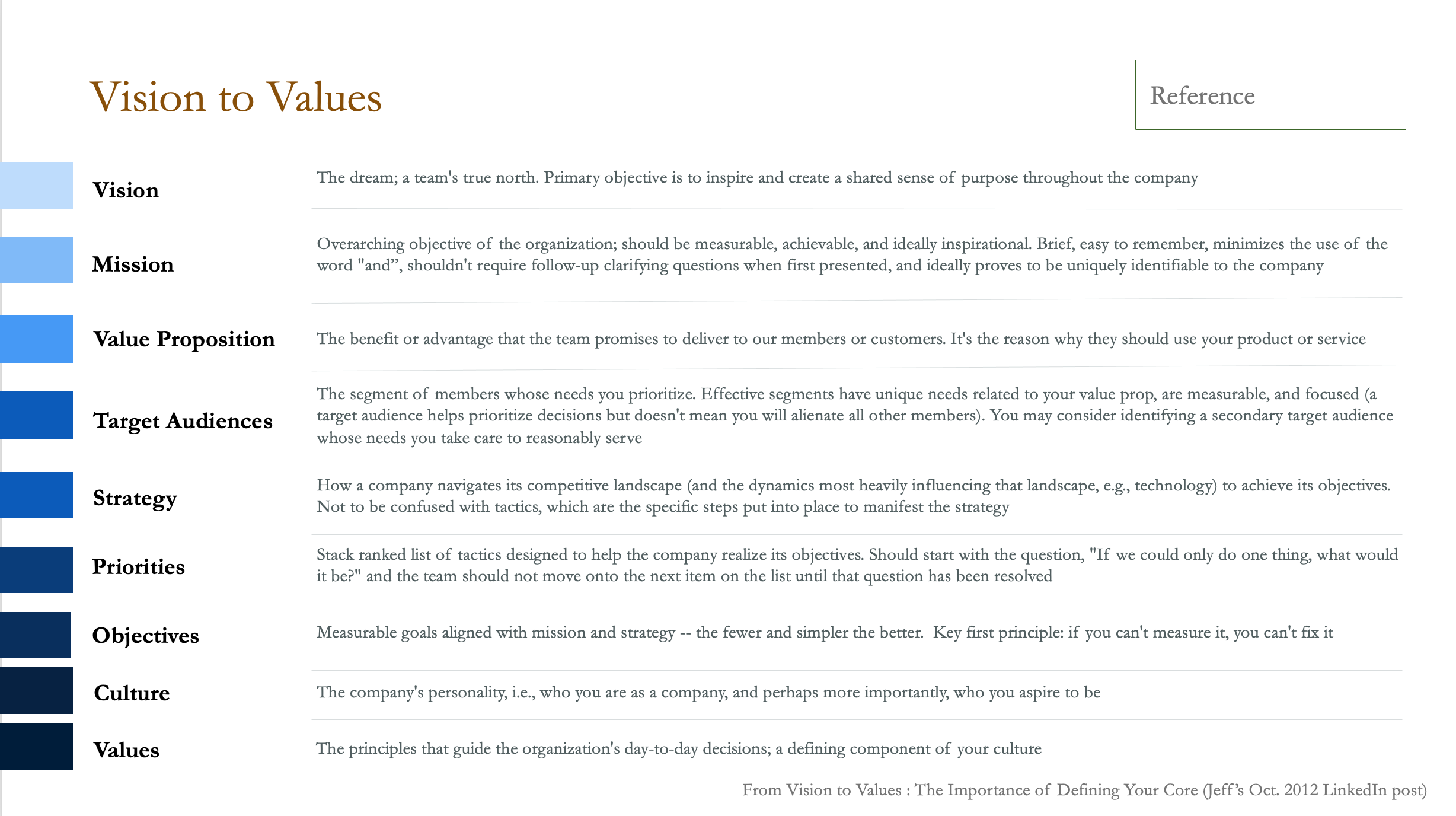
Tomer Cohen, LinkedIn’s chief product officer: “When I joined, Jeff Winter was the CEO. This is something that was an extremely big part of how we operated and thought at LinkedIn. Jeff codified the vision as being the dream. Ultimately, if you’re successful, what change are you making in the world? The mission was more of that tangible aspect that you can almost start measuring on a daily basis. Then we go all the way to values, by the way. We call this the “vision to values” process.” The flowchart.
Economist: “Silicon Valley may be coming down to earth. Not so tech’s big thinkers…“The tech industry has always told these grand stories about itself,” says Adrian Daub of Stanford University and author of the book, “What Tech Calls Thinking”. Mr Daub sees it as a way of convincing recruits and investors to bet on their risky projects. “It’s incredibly convenient for their business models.” Yet the impact could ultimately be positive. Frustrations with a sluggish society have encouraged them to put their money and brains to work on problems from science funding and the redistribution of wealth to entirely new universities. Their exaltation of science may encourage a greater focus on hard tech, rather than internet apps. If they can inspire future entrepreneurs to engage in the hard slog of building tomorrow’s trillion-dollar firms, their lofty theorising will have been worth it.”