How Velvet Rope Marketing can transform Customer Loyalty (Part 3)

Customer Pyramids

The ideas of customer loyalty are not new. A friend recommended a book published in 2000 – “The Customer Marketing Method” by Jay Curry and Adam Curry. The book discusses the customer pyramid as shown below:
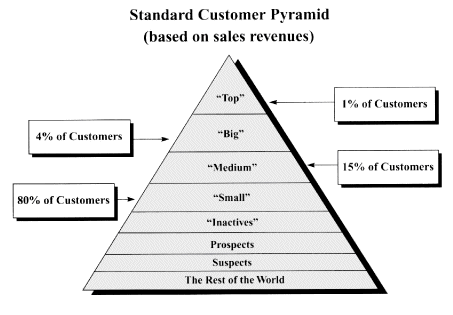
The simple 3-step customer marketing strategy as outlined by the authors is:

  1. Get new customers into your pyramid.
  2. Move customers higher in your pyramid.
  3. Keep customers from leaving the pyramid.

In other words, acquisition, retention and development of customers.

The authors also outline 10 lessons they have learnt from customer pyramids:

  1. The top 20% of the customers deliver 80% of revenues
  2. The top 20% of the customers deliver more than 100% of profits.
  3. Existing customers deliver up to 90% of revenues.
  4. The bulk of marketing budgets is often spent on noncustomers.
  5. Between 5% and 30% of all customers have the potential for upgrading in the customer pyramid.
  6. Customer satisfaction is critical for migration up the pyramid.
  7. Reasonably satisfied customers often defect to the competition.
  8. Marketing and sales are responsible for influencing customer behavior.
  9. Other departments and people also influence customer behavior—for better or worse.
  10. A 2% upward migration in the customer pyramid can mean 10% more revenues and 50% more profit!

Many of the lessons are timeless. A small fraction of customers account for disproportionate share of revenues and profits – think of these as the Best Customers. To paraphrase George Orwell’s famous quote in Animal Farm, “All customers are equal, but some customers are more equal than others.” Marketing efforts must focus on these customers, even as efforts are made to move some of the others (Rest) up to pyramid.

One can call it customer centricity or customer loyalty or any other term. The key to business success remains in identifying the category’s best customers, attracting and retaining them forever, and then getting them to recommend their family and friends. Data and technology make this easier and more competitive. That is where innovative thinking around customer loyalty as manifested in the ideas of Velvet Rope Marketing can make all the difference.

Tomorrow: Part 4

How Velvet Rope Marketing can transform Customer Loyalty (Part 2)

Loyalty vs VRM

The aspiration of every business is customer loyalty. In simple terms, customer loyalty translates into repeat business. The cost of acquiring a new customer is many times that of retaining an existing customer, hence customer loyalty also means higher profits for a business. If customer churn, a business cannot create a growth story and a profits flywheel. Thus, customer loyalty is central for business success.

I started thinking more deeply about customer loyalty during recent conversations with CMOs as part of the meetings I have been doing on Velvet Rope Marketing (VRM). VRM is about a focus on the Best Customers – the top 20% or so customers who account for a disproportionately high share of revenue and profits. For many businesses, Best Customers can deliver 60% or more revenues and greater than 100% of the profits – since many of the Rest Customers can be loss-making when acquisition and servicing costs are factored in. VRM’s key thesis is that Best Customers need a differentiated experience because of their importance to the business.

Loyalty programmes are one way to reward customers. The more a customer spends, the more points they earn. These points can in turn be redeemed for rewards. To make it more lucrative for loyal customers, tiers can be created where higher tiers generate more points. Airlines do this very well. There is hardly a frequent flyer to be found who is not part of the airline’s loyalty program.

As I see it, there are some very big differences between the standard loyalty programs offered by brands and VRM. Typically, anyone can opt-in to a loyalty program and start earning points. The brand does not control who joins. There is also very little experience differentiation – the points are linked to spending, and that’s about it. In VRM, it is the brand which decides who gets to be part of the differentiated experience. Think of VRM as ‘By Invitation Only’, an exclusive club whose entry is decided by an algorithm which calculates Customer Lifetime Value (CLV), a forward-looking and predictive metric based on the expected future transactions and their value. CLV, as used for VRM, can be a better measure of segmenting customers and determining Best Customers.

Any brand can offer a loyalty program with rewards. Customer Experience differentiation via VRM for Best Customers can become the moat a brand builds to ensure greater customer loyalty, higher spending and a ‘profits monopoly.’ This can give us a new definition for customer loyalty – receiving more than 50% of the spending by a customer in the category. We will build on these ideas in this series.

Tomorrow: Part 3

How Velvet Rope Marketing can transform Customer Loyalty (Part 1)

Customer Centricity Quiz

“We are a customer-centric company.” We hear this all the time. Yet, many companies lose out to competitors. Their customers surely did not think they were customer-centric! How can you ensure your company is not of those?

Here is a Customer Centricity quiz to help you understand how well your business builds the right relationships with your customers. Give yourself 1 point for every Yes that you answer.

  1. Do you collect data at every customer touchpoint (offline, online, call centre, etc.)?
  2. Are you able to get a unified view of every customer?
  3. Do you know the identity, revenue and profitability contribution of your best customers?
  4. Can you predict the lifetime value of all your customers?
  5. Is the lifetime value calculation based on recency AND frequency of customer transactions?
  6. Is there a differentiated experience that you provide to your best customers?
  7. Do you use info about your best customers to better target new customer acquisition and onboarding?
  8. Do you have a referral marketing program targeted at your best customers?
  9. If a best customer walked into a store or came to your website/app or churned (became inactive), would you know?
  10. Is measuring and increasing customer loyalty one of the top 3 CEO priorities?

Scoring:

  • 8-10: Congratulations! You (and your business) are a Customer Centricity Champion. The next phase is to look at actual implementation. Here are 5 more questions for you – same rules apply (count the number of Yes answers).
    • Do you practice the 4Rs philosophy – right message to the right person at the right time via the right channel?
    • Are you able to decide on the next best action for every customer to nudge them along in their journey?
    • Do you personalise the experience of your customers based on the data you collect?
    • Do your emails get delivered to the primary inbox of your customers? Do your push notifications get delivered to a majority (more than 75%) of your customers? (half point for each)
    • Do you have a culture of testing every communication for impact?
  • 6-7: Customer Centricity Learner. The DNA is there, but there is room for improvement. Look at each of the questions where you answered a No and prepare a plan to make that into a Yes. Your next action should be to convert one No into a Yes every quarter going forward – so pick one of the themes and begin.
  • Less than 6: Customer Centricity Newbie. You are leaving a lot of money on the table for competitors. There could be many reasons, but perhaps the most important is that customer centricity needs to immediately become a CEO priority and driven across all departments.

As you would have guessed, the customer centricity quiz is centred around customer loyalty and has embedded in it many ideas for actions that can help grow revenue and profits for your business. Creating lifetime customer loyalty is the most important goal of your business when it starts – and yet, many lose their way with the passage of time opening the way for attack by data-driven, customer relationship-centric, loyalty-obsessed competitors. Bringing the focus back to customer-centricity, attracting the best customers in the category and fostering lifetime loyalty is the key for growing revenues and profits.

Tomorrow: Part 2

Announcing: MartechBrain

I have started a new weekly show, MartechBrain. It is a Netcore initiative to probe marketers and digital leaders on the one idea that they are most passionate about.

Here are the first three episodes on YouTube:

MartechBrain will be available soon via Spotify, Google Podcasts and Apple Podcasts, and also via Netcore’s website.

New on hippoBrain

hippoBrain, the long-form conversation series that I had launched with Jaimit Doshi, has been growing with a new episode each week. We are at 8 episodes now:

    • Vivek Bhargava (Denstu;  ad-tech authority)
    • Kartik Jain (DBS, ex-HDFC Bank; marketing maestro)
    • Anindya Ghose (NYU Stern; mobility and AI guru)
    • Sandeep Miital (Cartesian Consulting, deep on consumer analytics)
    • Geetansh Bamania (Rentomojo; entrepreneur)
    • Nilesh Patel (Leadsquared, B2B SaaS)
    • Rahul Chandra (ex-Helion; Arkam Venture Capital)
    • Ambarish Gupta (ex-Knowlarity, Basis Vectors — a B2B SaaS fund)

    Coming up:

    • Ramaraj (ex-Sify)
    • Arvind Sivdas (Kabaddi Adda, sports analytics)
    • Jayesh Ghatge (ThoughtWorks)
    • Neha Barjatya (Rajshri Entertainment)

    Coming soon: MartechBrain — to probe the best minds in marketing and digital on what they are most passionate about.

Market Movers Conversation on Velvet Rope Marketing

I spoke to Al Lalani, CEO of Annex Cloud, for their Market Movers show.

The chat is “about changing from a push for acquisition to a retention-driven loyalty program. Rajesh offers advice to marketers on what areas should be focused on to aid in a company’s success in these unsure times. He also shares his approach to building a continually profitable machine through his “Next, Best, Rest” system.

An excerpt:

The framework that I like to use is really the best customers, that’s the top 20%. And then we have the other 80%, the long tail of customers, and then the next customer. So best, rest, and next.

Now the first step in this is really to collect all of the customer data, especially the transaction data, offline, online, whatever it is. And the other information about the customers that you can get through the app, on the website, et cetera. The first step is really how do we calculate CLV right as we spoke about.

Once you do the CLV calculation, then we are able to do the customer segmentation. So typically, businesses will find that the top 10, 20% of customers are generating disproportionate value, maybe 50, 60, 70% of revenue. And if they actually get down to calculating profitability, they may find that the profitability of these customers actually could exceed 100%, because there are many other customers in the long tail, who will be negative contribution because of the cost of acquisition and the cost of servicing.

So these customers, the best customers are very, very important for a business. Identifying these customers, retaining them, and then looking for the next customers who are like these customers, that becomes very, very important. So that’s really the core of this idea around Velvet Rope Marketing, think of it like Red Carpet Marketing. Basically, how do you create an amazing experience for the best customers so they never want to leave your brand?

That’s the key to growth and profitability, especially in these times. In a way we think about it, retention now is the new acquisition, given that it’s harder to acquire new customers because marketing budgets are getting slashed. And your excellent point which you made in one of your recent presentations, that in 2008, a lot of customers actually joined or changed their brands. And that’s even, therefore, more important that companies focus on their best customers at this point in time.


Rethinking Referral Marketing (Part 11)

For me, thinking deeply about marketing is something that is quite new. It is only in the past few months that I have started probing into how the current marketing techniques can be improved in a world of digital customers, unlimited data and low barriers to customer churn. I have to the field as somewhat of an outsider, even though Netcore has been in the business of selling marketing solutions for many years. That has helped me bring a new perspective to the existing knowledge base of ideas.

Velvet Rope Marketing was the first big idea. While the core concept that a small number of customers can account for a disproportionate share of revenues and profits has been around for a long time, what I tried to do is to put together an end-to-end framework that covered concept to execution to measurement. It was during this process and through the conversations that I had with many CMOs and digital heads that the problem statement for thinking about referral marketing emerged.

As happens so often with new ideas, all that’s needed at times is for a newcomer to come in and combine existing building blocks differently to create something different. This is what I have tried to do in this series on referral marketing – by combining three elements that already existed:

  • Best customers, who can get others like them through their social networks
  • Lifetime value, which can create greater rewards and incentive for best customers for referring others like them
  • Multi-level network, that further enhances the value of referrals for the best customers

Some additional tech-led tweaks can also help in making referral marketing as core to marketing as adtech and martech are: ensuring that both referrer and the person referred get the same initial benefits (either both get it, or none get it), simplifying the process of referring (ask a new customer at sign-up about who provided the nudge), and creating a cross-brand rewards program and adding game-like elements to provide far greater incentives than what a single brand could do.

Hopefully, these ideas can serve as the foundation for transforming referral marketing. Perhaps, Velvet Rope Marketing has found its perfect companion – Velvet Circle Marketing?!

Rethinking Referral Marketing (Part 10)

During the 2014 Lok Sabha election campaign, when I was assisting in the election campaign of Narendra Modi, my team at Niti Digital came up with an interesting twist on the Amway-type multi-level marketing program. Our goal was to get Modi supporters to identify other Modi supporters, and let us know. This way, we could ensure that all of them received the right nudges and reminders on the polling day to go out and vote.

So, we came up with an idea called “Namo Number”. An existing supporter needed to SMS their VoterID to enroll. They could then get others to also show their support by asking them to send their VoterID along with the mobile number of the referrer. This way, a tree could be built. We extended this to two levels and gave one point for every sign-up. (To keep it simple, we did not distinguish between the first and second levels.) The total count of the tree was the Namo Number.

We showed a leaderboard in real-time, and offered an incentive that those with the highest Namo Numbers would be invited to the BJP HQ in Delhi for an interaction with the party leadership.

The program worked very well – we ended up getting well over 10 lakh SMSes across states. The VoterID helped us identify the supporters at a booth level who could then be prioritised for the turnout operation on election day. It also helped identify the “super spreaders” – those with a large influence in specific areas.

Now imagine applying this same idea to the world of referral marketing. Allow the best customers to create a multi-level network of referrals for which they get credit based on the lifetime spends of the referred customers. This is how brands can build customer evangelists and measure their impact in a transparent manner.

The one big difference between what brands like Amway and others do is that there is no cost to joining. Each of the best customers can decide if they want to participate or not. There is no pressure and there is no payment; there are just good rewards as a recognition of the contribution made to the growth of the brand they love and are loyal to.

Taken together, the three ideas – focusing on best customers, rewarding them based on the lifetime value of their referrals, and extending the rewards program to the downstream of the referred customers – can transform referral marketing and make it a very powerful parallel track for new customer acquisition.

Tomorrow: Rethinking Referral Marketing (Part 11)

Rethinking Referral Marketing (Part 9)

The second issue with current referral programs is that they do not offer rewards based on the lifetime value of the referred customer. So, all that one gets as a referrer is some small one-time incentive – either a cashback or a free ride or some additional points. None of this is exciting to make referral marketing a key plank in new customer acquisition. It thus ends up just becoming another checkbox in the marketing toolkit.

Customers have different lifetime values. When a new customer comes in through a referral, the brand is not incurring marketing costs in acquisition. It can thus afford to reward the person the referring customer.

Let us take an example. Suppose the lifetime value of a customer just acquired is Rs 20,000. A brand may have spent Rs 2,000 or so in acquisition costs as part of a marketing campaign. Instead, it now no longer has to spend all of that money. It could take some part of the money saved and split it in three ways: give both the existing referring customer and the newly acquired referred customer the same initial incentive of say Rs 300 (for a total spend of Rs 600). It could then allocate 5% of the future spend by the new customer as an incentive to the referring customer, who would thus earn Rs 1,000 in the coming months and years. This creates a substantial incentive and encourages the best customers to make sure they get more future best customers. [A point to note in the example above: the payment need not necessarily be in cash. It could be through an alternate currency (virtual coins, points, etc.) also.]

Taken together, the first two solutions offer a big upgrade to existing referral programs. The focus on best customers ensures that the brand can get more higher value customers. The incentives offered by giving rewards linked to the lifetime spend of the new customer also ensure that quality is emphasised over quantity in the referral process.  Our next upgrade to the referral marketing will, quite literally, take it to another level.

Tomorrow: Rethinking Referral Marketing (Part 10)

Rethinking Referral Marketing (Part 8)

Let’s begin with the point about best customers. The referral programs that we see today do not factor in the differences between their customers. As such, there is a lowest common denominator element across these programs. Thus, they are limited to offering small incentives.

Just as brands should use CLV to segment their customers and create a differentiated experience for their best customers (what I have termed as Velvet Rope Marketing), they need to do similar for their referral programs – use the same segmentation and create a different program for their best customers.

The key reason for this is that while all customers may not have an affinity towards the brand, the best customers do! They are the most loyal, highest spenders and have the greatest lifetime value. As such, they are willing to overlook all deficiencies with the brand or products (if any) and ignore competitors. They will thus be also willing to champion the brand to others – if asked and if given an incentive. Some may do so on their own – but recognition of their contribution can give a fillip to the referral activity.

And yet, no brand that I have come across has a referral program that is focused on just their best customers. In fact, most brands do not know who their best customers are. Solving both of these problems can be a big booster tor revenues. This is because not only will the best customers appreciate the special experiences, they will also help get more like them – more future best customers. This will be many times more cost-effective for the brand than running ad campaigns to a wider audience.

All we have to do is to think about ourselves as customers. We know people like us. And if we are the best customers of a brand, it is very likely that the people we know could also become best customers of that brand. This is the growth flywheel brands need to create.

Tomorrow: Rethinking Referral Marketing (Part 9)