Email 2.0: Making Email Cool Again (Part 3)

Benchmarks

Netcore will be publishing its Email Benchmark Report 2022 soon. From the introduction:

2021 proved to be a continuation of 2020 in many respects. Just like everything else in our lives, email marketing went through an evolution.

Email marketing prevails as one of the most trusted channels at the marketer’s disposal to connect with customers, convert them into loyalists, and deliver on the bottom line. Email has taken big leaps and bounds in 2021 with interactivity, privacy, and multimedia.

Since the last two years of the global pandemic, email has transformed to become a crucial channel for personalized and conversational marketing. Providing a great customer experience through emails has been the preferred approach.

Email marketers reduced their frequency of emails but increased personalization, smart segmentation, and automation. We observed that marketers are becoming more AI-savvy as advanced technologies help to predict their needs, target audience, and make their job easier.

2021 was a year of growing awareness of user privacy, brand authenticity, nurturing customer relationships, and optimizing the customer experience. The traditional ways of marketing campaigns and sales pitches have no place in today’s digital-first marketing landscape.

The only way for you to have lasting success with your marketing programs is to keep up with these changing scenarios and master the email channel. In 2022, your email program needs to not only communicate but also create tailored experiences for your customers.

As user privacy becomes central with Apple’s MPP regulations, data attribution will become much deeper in 2022. Collecting zero-party data and analytics will become crucial for every experience-focused marketer in 2022.

Among the key metrics from the analysis of the emails:

  • Average open rate: 8%
  • Average click rate: 0.25%
  • Average click to open rate: 3%

In other words, for every 1000 emails, 800 of them are being ignored and just 25 emails are clicked through to the brand website or app. And these numbers are for the channel with the best RoI! Without their push messages being seen and acted on, it’s little wonder that brands, facing a serious attention recession problem, are pushed towards new customer acquisition. And yet, the focus for brands is on optimising acquisition and not building a better pipe. This is the biggest mistake being made by brands. By shifting budgets from adtech to martech (and Email 2.0), brands can reduce adwaste through a better hotline, ad targeting, personalisation and intent data. This is where Email 2.0 pioneered by Netcore comes in. Netcore’s enduring legacy of innovation, growth and relationships gives it a unique position to envision the future.

Email 2.0: Making Email Cool Again (Part 2)

Evolution

I wrote about Email2 a few months ago: “Even as email service providers (ESPs) move up and down the stack to add offerings like CDP (customer data platform) and martech features (journeys, orchestration, omnichannel personalisation), the core email channel itself is evolving. The triad of AMP, Ems, and Microns – what I term as Email2 – will transform how customers engage with emails, and help brands in their continuing quest for deepening customer relationships.” I added: “Email2 will bring creativity back into email – brevity, smart copywriting, simplicity of design, and story-telling. It is about persuasion and nudging, rather than hard-selling. It is about getting attention first and brand building, rather than jumping straight into pushing for a purchase. Microns use the Subject line to create the excitement of earning rewards and thus grab attention in an Inbox of otherwise same-to-same Subject lines. Ems limit the display area to a mobile screen thus driving the need for a single, sharp message. AMP offers the opportunity to bring in interactivity – a touch or a swipe which draws the recipient in.” In the series, I also discussed new ideas like Hooked Score, Atomic Rewards and Progency.

In the months since I wrote the series, I have been thinking much more about Email 2.0 and its potential to enhance the user experience and solve the attention recession problem. In this series, I will reframe the Email 2.0 discussion around five innovations: Hooked Score, Atomic Rewards, Ems, AMP, and Progency. Together, they can engineer a habit revolution, convert the end customer’s “delete” mindset into “delight”, and make email cool again.

The reason channels like email retain their importance in the world of Instagram and Tiktok is that email is a push channel and emails are sent to identified users. Push channels are important because they help bring customers back to brand properties (website and app). In the absence of engagement on push channels like email, SMS and push notifications, brands will be forced to use intermediaries like Google and Facebook to do the outreach to their own customer base at prohibitively high costs. Push channels are an integral part of the “omnichannel personalisation” vision that brands have.

My company, Netcore Cloud, has been involved in the world of email marketing for more than 15 years. We began in response to requests from our enterprise customers to help them do “mass mailing” to lists – since we already had email expertise and were helping set up and manage their internal email servers. Through these years, email kept growing and growing. Now, Netcore does over 18 billion emails a month and serves brands globally. In India, our analysis shows that 75% of emails sent by brands to their customers go through Netcore’s platform. Email’s success has helped Netcore extend into additional layers in the martech stack – automation, journey orchestration, analytics, personalisation, and nudges (product experience.) Having been among the “originals” (early Email Service Providers), Netcore is now at the forefront of reinventing email.

Email 2.0: Making Email Cool Again (Part 1)

Like ICE to EV

For a hundred years, cars have used internal combustion engines. The burning of fossil fuels have been shown to be harmful to humans and the environment. Tesla’s innovations in batteries and software have laid the ground for a new type of car: electric and autonomous, completely transforming the driving experience and creating a better future for us and our planet.

Modern marketing is on the cusp of a similar transformation moment. Brands have been plagued by “adwaste” – the half of their spending that ends up in reacquisition of customers and wrong acquisition causing great harm to company P&Ls. Customers are flooded with me-too messages from brands in their inboxes which they either ignore or delete. The result: customers have stopped listening to brands. This is leading brands down a negative spiral of overspending on acquisition and less on retention, growth and cross-sell, thus increasing brand erosion.

Marketing needs a Tesla-like solution to transform what is at the core of commerce – the brand-customer relationship. Welcome to Email 2.0.

**

Marketers are wasting half their budgets in the mad race to acquire new customers. With customer acquisition cost (CAC) rising rapidly year on year, this “doom loop of ad spending” is eating away most marketing budgets, leaving very little for building direct, data-driven deep relationships with their existing customers. Unless addressed quickly, this “adwaste” is going to cause lasting damage to brand balance sheets – and even threaten their existence. Big Tech is today’s equivalent of Big Oil – sucking away the oxygen of profits from everyone else. The flawed actions of modern marketers has meant that they have become collection agents of the ad giants – digital serfs, sacrificing their company’s profits at the altar of Google, Meta (Facebook) and Amazon, the Gods of the Tech Age.

The solution is not about trying to build the equivalent of “green oil” by optimising spends on adtech, reinventing cookies and creating privacy frameworks. The answer to the problem of adwaste lies not in building a better mousetrap but eliminating it entirely. The only way to do this is to address the problem that is at the root of it all: attention recession on the part of the consumers. Attention deficit leads to retention recession which in turn causes continuous customer churn. So far, the only solution that marketers have come up with is with transaction-linked incentives in the form of discounts and offers. All these gimmicks do is negatively impact profitability without improving loyalty.

What marketers have missed is that addressing attention recession requires building a hotline to their customers and taking the 10-20% view rate of push messages to 80-90%. Only then will they be able to lower adtech spends to get their existing customers to listen, gather more data, drive greater revenue growth, and thus improve profitability. Without sustainable profits, a business becomes a money guzzler and eventually dies when investors pull the plug on new funding.

Solving the attention recession problem, eliminating data poverty, reducing CAC is the pathway to driving profitable growth and must become the top priority of every marketer. The starting point has to be reinvigorating push messaging because the only alternative to bring customers back to the website or app for transaction push messaging is massive spending on branding. Email remains the best of the push messaging channels and can in fact improve the efficacy of the other channels. Therefore, the focus needs to be to make email cool again – Email 2.0.

Email 2.0 is the Tesla-like innovation, changing the customer mindset from delete to delight, driving engagement and habit creation, and powering exponential forever profitable growth. It is the only antidote to brand extinction because if customers are not listening, there is no point for a brand to keep speaking. Email 2.0 creates habits by making the sent seen and the seen actioned. It drives mental availability for the brand by becoming a utility in the lives of customers. The power and value of Email 2.0 can transform CMOs into Chief Profitability Officers of their businesses, and perhaps into future CEOs. Email 2.0, like Tesla, can truly make tomorrow’s world a better place for all of us as custodians of brands and customers of products.

Martech 2.0 and Web3: Solving Advertising’s 50% Problem (Part 14)

In Summary

We started by shining light on a problem that has been around for a hundred years: the 50% waste in advertising. Until now with its combination of digital customers providing data via their devices, it was a problem that had no solution. Now, it is possible to identify where the 50% waste is happening – reacquisition of churned customers and wrong acquisition where new customers exit rapidly. Solutions to this modern 50% problem have not been forthcoming because of the seductive allure of new acquisition, the availability of easy money from investors, and the CEOs’ priority of growth over profits. There is now trouble in paradise.

The cost of new customer acquisition is rising faster than ever before – just witness the 30-40% year-on-year growth rates of Google, Facebook (Meta) and Amazon. Easy money is going to slow down or disappear. This will force CEOs to focus on growth with profitability – and even going as far as to prioritise profitability over growth.

It is in this context that the ideas outlined in this series (and through my past writings) need to be seen. There are multiple innovations which when combined together can help create a new future for marketers and martech. It is a world in which they can have it all – drive exponential forever profitable growth. Here are the key takeaways:

  • To solve the problem of rapidly rising customer acquisition costs, marketers need to address adtech’s 50% waste problem due to reacquisition and wrong acquisition
  • The starting point for fixing this is not optimising adtech, but focusing on existing customers and martech
  • Marketers need to make shifts in the 5 Rs of retention, repetition, referrals, reactivation, and replenishment
  • Three innovations can help power the modern marketer’s transition: Atomic Rewards, Martech 2.0, and Progency
  • The marketer’s new map is about Pipe, Partitioning, and Prospecting
  • Done right, this is the path to profitable growth and creating a “profits monopoly”

**

PS 1: There is a famous line in Tolkien’s “Lord of the Rings”. Gothmog says, “The Age of Men is over. The Time of the Orc has come.” Of course, the Orcs are the evil ones and eventually lose. But to borrow the phrasing, what I can say is: “The Age of Adtech is over. The Time of Martech has come.” And hopefully, this time it will be a happy ending for brands and customers!

PS 2: I have been trying to think of a new name to describe this new thinking which combines Martech 2.0 and Web3 (along with the idea of a Progency.) Atomic Marketing, as a signal to the importance of Atomic Rewards? Or maybe Exponential Marketing, to indicate how exponential growth can now be possible? Or Profitable Marketing – because marketing has always been seen as a cost centre? Perhaps, replace Marketing with Martech because that is what it is all about – marketing powered by tech. I don’t have an answer yet. It is a question for another day and a future series!

Martech 2.0 and Web3: Solving Advertising’s 50% Problem (Part 13)

Prospecting

The final question to address is that of the Next customers – the new acquisition. Today, this is the central focus of a marketing department. In the new map, this becomes an important but small program because it is the existing customers who become the key growth drivers. Two ideas can help marketers dramatically slash their adtech spending.

The first idea is referral marketing. The best advocates for a brand are its happy customers. Most existing referral programs tend to focus on getting any and every existing customer to try and attract new ones. This is a mistake. What brands should focus on is constraining referral marketing and offering it only to the Best customers because they are likely to get customers like them who can become tomorrow’s Best customers. Such referrals should be handsomely incentivised because a good referral cuts down the cost of new customer acquisition to zero. Tokens as part of the Atomic Rewards program can be a very good incentive for both the referred customer and the referrer.

The second idea is to create an adtech-martech bridge to ensure much better targeting in new customer acquisition. By analysing data from Best customers and using only this (rather than data from all customers), the acquisition program via the likes of Google, Facebook and Amazon can be sharper. ROAS (return on ad spend) should be the metric that should be measured and connected to CLV. Of course, the fundamental premise for this program’s success is the availability of zero- and first-party data. That in turn needs a CDP (as part of Martech 2.0) and incentives for customers to share their preferences. AMPlets in emails can use the footer space to craft a ‘zero-party data’ journey for each customer. The better a brand understands its buyers and the buyer journey, the better the acquisition program can be. Acquisition is where costs need to be controlled because the spends here are open-ended and exponentially increasing. Done right, brands can generate huge savings which can go straight to the bottomline.

Adtech spending thus is at the bottom of the funnel rather than being at the top. This inversion is what will propel brands to profitability. The Adtech era has made marketers lazy – pour money to the Big Tech platforms and watch as new customers steam in. But this has come to a huge cost – because there is little of the budget left for spending on building better relationships with existing customers. Unless this funnel is inverted to maximise spending on existing and especially the Best customers, brands will not be able to escape the pull of continuing cash burn on new acquisition. Referrals done right and the bridging of martech data to drive adtech spending are the two ways to stop the 50% waste.

Martech 2.0 and Web3: Solving Advertising’s 50% Problem (Part 12)

Partitioning

Attention is a two-way street. Just as brands want customers to pay attention to their marketing messages, customers also want brands to make them feel special. While tech can help with personalisation to create unique experiences for every customer on the website or app, there is much more that brands can do. This is where the idea of Velvet Rope Marketing (VRM) comes in. It has 4 key foundational ideas:

  • All customers are not equal; some customers are more equal than others. In most non-subscription brands, an analysis will show that typically 20% customers will account for 60% of revenue. (In fact, if brands can measure profitability, they will find that these Best customers account for more than 100% of profits – because the long tail of other customers do not have enough revenues to cover their cost of acquisition and servicing.) This 20-60 rule can be considered as the Power Law of Marketing.
  • Calculating Customer Lifetime Value (CLV) is the way to segment customers and identify the Best customers. CLV needs to be a forward-looking measure and done right; there are many ways to calculate it incorrectly, and this will lead to improper identification.
  • Brands need to create differentiated experiences for these Best customers in order to ensure they never churn, maximise their spend, and can bring in their family and friends via word-of-mouth spread. For this, brands need to think “royalty” and not just ”loyalty”. Ease, access and exclusivity are three dimensions for creating memorable experiences for the Best customers.
  • Finally, decoding the Best Customer Genome (BCG) can provide a template for nudging other customers along the same path, and also providing the input for “lookalike” acquisition campaigns.

Implementing VRM right entails creating a separate SBU for Best Customers. This is akin to how airlines have separate teams for Business Class customers.

The next two partitions based on CLV are for Rest and Test customers. Test customers are easy to identify – they are the ones who are inactive. They came, engaged, perhaps did a purchase or two, but have now gone dormant. In most brands, these will account for at least a third of the total customer base. The goal must be to reactivate these customers; the alternative track of retargeting and reacquisition via Big Tech can be very expensive. A Progency is ideally suited for this.

That leaves us with the middle 50% or so customers – the Rest customers. The long-term goal must be to get them to become Best customers; the short-term goal is to nudge them along in their customer journey to the next best action, which can be identified by matching genomes against the Best customers.

So, a brand needs 2 internal teams to manage customers – one for the Best customer, and one for the Rest. (A smaller group can handle the outsourcing of Test customers to a Progency.) Martech 2.0 is what these internal teams need – an AI-powered full-stack martech platform that replaces various point solutions and provides a unified customer view. Retention, growth, and cross-sell must become the organisation’s mantra – replacing the attractiveness of showcasing just the number of new customers acquired. This is a CEO-level mindset change which then needs to permeate through the rest of the organisation. Enriching the lives of existing customers rather than enticing new customers is the surest path to success.

Martech 2.0 and Web3: Solving Advertising’s 50% Problem (Part 11)

Pipe

The first focus for marketer’s wanting to get out of the doom loop of adtech spending is to create a pipe and hotline to their existing customers. This means solving the attention recession problem and converting the “delete” mindset (for incoming brand messages) to “delight”. This is where the innovation of Atomic Rewards with its Web3 crypto tokens comes in.

Brands push out a lot of messages over multiple channels to customers. The tragedy is that most are ignored. Open rates in emails for marketing messages are 10-15%, meaning 85-90% messages are ignored. SMS open rates are even lower. Push notifications are blocked by over half of app users – and more often than not, these are likely to be the Best customers. Without an active pipe to one’s existing customers, marketers have no way of communicating new products and offers. This is the problem that can be solved by the pan-brand crypto tokens.

Armed with these tokens, marketers can now get to work recrafting their push messaging strategy:

  • Every push message to have tokens as rewards. Incentivise customers for streaks – successive opens. This will lead to a habit of opening all messages.
  • Email remains the best channel from an RoI perspective. Make it the first channel for implementing Atomic Rewards for opens and clicks.
  • Use AMPlets in emails to make them interactive. This will help in getting feedback on the email and collect zero-party data. Tokens as rewards will increase response rates. Various studies have shown that customers are willing to share personal data in return for small incentives. (Collecting data is also critical for D2C brands who sell via marketplaces; acquisition costs on Amazon are also spiralling. Atomic Rewards can do the trick for such brands also.)
  • Use Ems to create mental availability for the brand by sending informative microcontent in story form. The idea is to become a utility in the life of the end customer. Tokens can incentivise open streaks. A Progency is ideally suited to do this.
  • Measure stickiness via Hooked Score, a 30-point exponential moving average. This can help track who are the most engaged users and correlate with transactions.
  • For mobile first companies, the biggest risk is a user uninstalling the app in the first few days. To prevent this, two ideas can be implemented: tokens for creating a habit loop, and getting an email address to open up an alternate channel for interaction in the event that the app is uninstalled.
  • Over time, the Atomic Rewards program can be expanded to other push messaging channels beyond email.
  • Begin with a 30- or 60-day pilot to do A/B testing and measure the uplift that can be derived via Atomic Rewards. This can be run in parallel with the existing marketing campaigns on a subset of the customer base.

All these ideas taken together will go a long way in strengthening the pipe and creating a hotline to existing customers. The success of the next set of initiatives lies in the pipe: once customers are paying attention and engaging with incoming messages, half the battle is won.

Martech 2.0 and Web3: Solving Advertising’s 50% Problem (Part 10)

Three Innovations

The three innovations that form the kernel of the marketer’s new map are Atomic Rewards, Martech 2.0, and Progency.

Atomic Rewards

Many brands have loyalty programs linked to transactions and money spent. Atomic Rewards can be thought of as a loyalty program linked to attention and time spent. (It can later be extended to transactions also.) It is about incentivising customers for attention and engagement, and prodding habit creation such that they do not ignore incoming brand messages. It builds on a simple idea: to get customers to pay attention, pay them for their attention (else you will pay Google and Facebook 100X more). Atomic Rewards gamifies attention, and lets marketing change customer behaviour. For example, marketers can reward customers for their email actions like opens, clicks, providing rating/feedback, streaks, and proffering zero-party data (preferences). Atomic Rewards can be linked to existing brand loyalty programs, but a better way is to use a Web3 platform to ensure the earned points in the form of crypto tokens also become a useful investment over time.

As I wrote in a previous essay which offered a futuristic view of the success of the Web3 tokens: “The turning point came a few months after the launch of the tokens when an independent research study confirmed what the early adopters (brands and ESPs) had started to sense: tokens were driving changes in behaviour and solving the attention recession problem. This kickstarted the flywheel for tokens adoption: more brands started using them in emails directly and via email service providers, the exchange started buzzing as brands needed to buy tokens in the spot market leading to a steady increase in value, and consumers started wanting to earn more tokens by doing the actions desired by brands… Tokens embedded in emails helped drive meaningful actions. Brands controlled who could earn tokens, and thus had some measure of control on preventing fraudulent and frivolous behaviour. Consumers liked the fact that their attention (time) was no longer being taken for granted.”

Martech 2.0 Stack

Martech 2.0 addresses the problems of present day point solutions by creating a full stack. The chart below from an earlier essay captures the shift.

As I wrote then: “Martech 2.0 will be the “real thing” – what marketing should always have been with its focus on maximising lifetime value by building deep, engaging and rewarding customer relationships. The transaction is an outcome, rather than the only goal. With the focus on retention, reactivation and referrals incentivised at the right times with rewards, revenues will rise and so will profits.”

Progency

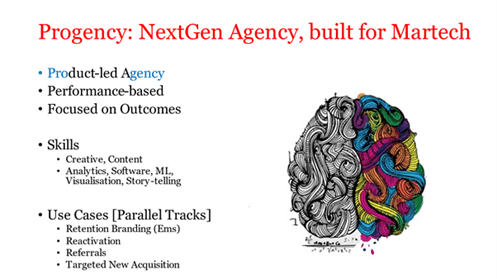
Progency is an agency built on top of a Martech 2.0 product platform; it is a product-led agency. It combines platform, people, and process into a unified offering priced on performance. It makes martech as simple as adtech is: identify a goal and outsource it to an agency. In this case, the agency is powered by tech. As I wrote previously: “The progency is actually a very scalable tech powerhouse with the full stack martech platform as the machine. Brands can either buy the machine itself (in effect, rent a version of it, since it’s all delivered from the cloud) or hire the machine developer to deliver the outcomes… Its pitch is simple: we will deliver the outcomes you need, we will get the job done for you. We have the machine and the operators. No one knows the machine better than we do. We constantly make the machine better. You don’t need to worry how it works. (No marketer knows how the targeting machines of Google and Facebook work.) You can of course buy the drill, but we are here to give you the hole that you really desire. You pay based on the performance, so we are on the same side.”

**

We are now ready to drill down and construct the marketer’s map with its three stations: pipe, partitioning, and prospecting.

Martech 2.0 and Web3: Solving Advertising’s 50% Problem (Part 9)

Marketer’s New Map

We are now ready to chart out a new roadmap for the marketer for cutting back out-of-control adtech spending by eliminating the 50% waste going into reacquisition and wrong acquisition. The big insight that a marketer needs is that the starting point is not focusing on optimising the adtech spend but to begin with the existing customer base. With only a tenth of marketing budgets being invested on building relationships with existing customers, it is little surprise that marketers are unable to maximise customer lifetime value and control churn. Pivoting to a martech-led strategy is the only way to pull back adtech budgets feeding the growing CAC (customer acquisition costs) monster.

The map has three stations en route its destination to exponential forever profitable growth: pipe, partitioning, and prospecting. Pipe is about solving the attention recession problem with existing customers. Only with an alert and active customer base can marketers persuade them with their messages. Partitioning is about segmenting the customer base into three: Best, Rest and Test customers. Best customers need a separate SBU focused on providing differentiated experiences since they are the ones who will deliver the profits. Test customers are the in actives, and need to be outsourced to a Progency for reactivation. The in-between segment of Rest customers is where business-as-usual marketing needs to be done to nudge them in their purchase journey towards the next best action. Prospecting is about the Next customers. This is where two ideas not being currently leveraged come into: an improved referrals program which persuades Best customers to open up their network of family and friends, and an adtech-martech bridge that targets the right set of customers based on the genome of Best customers.

This is a new map for marketers. Very little of this is being done today. In most brands, the pipe is non-existent because a very large percentage of brand messages are being ignored. Lack of attention results in a break in the brand-customer relationship because there is no other way to bring existing customers back to the properties (web and app) other than huge investments in branding. Partitioning is being done on trivial attributes rather than customer lifetime value. Without CLV, marketers are unable to correctly identify who the brand’s Best customers are. The experience thus becomes commoditised for all, and the high and loyal spenders tend to drift away because they are also the ones constantly being targeted by competition with attractive offers to switch. Also, the dormant customers are not being reactivated and instead end up being retargeted for new acquisition at many times the cost via the adtech platforms. Prospecting is being done in a vacuum, in many cases by an independent team that doesn’t talk to the martech team to understand the attributes of Best customers. Also, referral programs are non-existent in most brands.

Adtech and martech are both broken. Only by changing the starting point to martech can brands embark on a new journey. As Einstein said, “Insanity is doing the same thing over and over and expecting different results.” It is time for marketers to end the adtech spending insanity by embracing three innovations that we have discussed: Atomic Rewards (in the form of Web3 crypto tokens), Martech 2.0 stack, and Progency.

Martech 2.0 and Web3: Solving Advertising’s 50% Problem (Part 8)

References

Each of the ideas mentioned has been independently covered in my earlier writings and a few talks. (What was missing was a framework to unite them together to solve the larger problem of spiralling adtech spends – which is what this series does.) The ones in bold are good starting points.